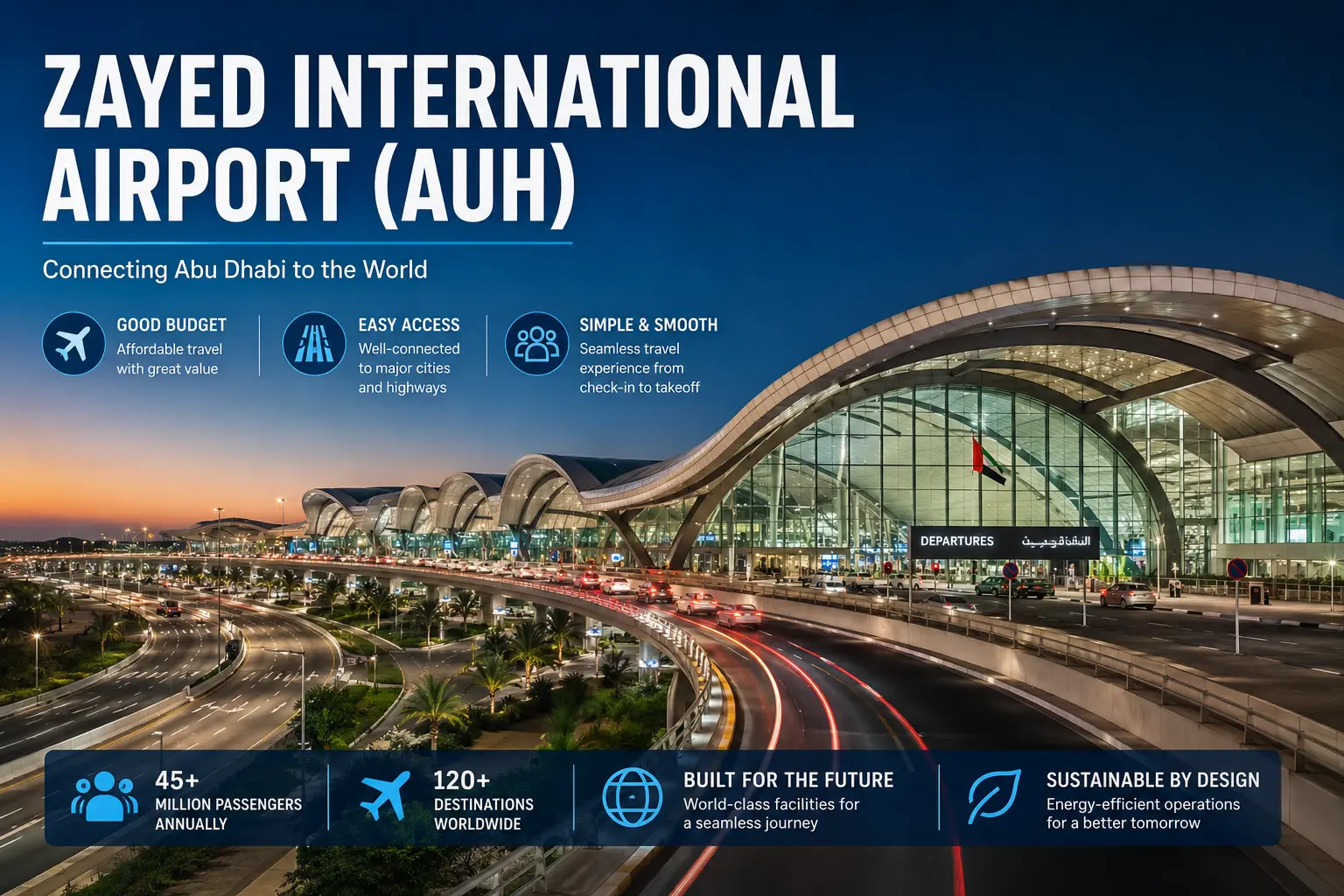
Zayed International Airport (AUH) is the flagship aviation gateway of Abu Dhabi and the home base of Etihad Airways. In 2025, the airport handled a record 32.5 million passengers, a 12.8% increase over the previous year and the first time in history that Abu Dhabi’s annual passenger traffic has crossed the 30 million mark. Across all five airports in the emirate, traffic surpassed 33 million, doubling over the past three years.
The airport has emerged as the fastest-growing mega airport in the Europe, Middle East and Africa (EMEA) region. In its second full year of operations since the opening of Terminal A, AUH accounted for roughly 98% of all passenger traffic and 73% of aircraft movements in Abu Dhabi. The airport served 8.59 million passengers in the fourth quarter of 2025 alone, a 13.8% increase year-on-year.
Terminal A, which opened in November 2023, is the centerpiece of AUH’s transformation. The 742,000 square meter facility, designed by Kohn Pedersen Fox Associates, has a capacity of 45 million passengers annually and ranks among the most architecturally striking airport buildings in the world. It is the first airport terminal in the world to incorporate all nine biometric touchpoints, and it processes up to 11,000 passengers per hour.
Abu Dhabi is already planning the next phase of expansion. The airport operator is working on a detailed master plan to increase capacity from 45 million to 65 million passengers by 2032, with construction expected to begin in late 2027. This guide covers everything about Zayed International Airport: its history, Terminal A, airlines, facilities, expansion plans, and travel tips.
Quick Facts at a Glance
| Detail | Data |
| Official Name | Zayed International Airport |
| Former Name | Abu Dhabi International Airport (until Feb 2024) |
| IATA Code | AUH |
| ICAO Code | OMAA |
| Location | 30.6 km east of Abu Dhabi city center, near Yas Island |
| Area | 15,000 acres (6,000 hectares) |
| Elevation | 27 meters above sea level |
| Annual Capacity | 45 million passengers (Terminal A) |
| Planned Capacity | 65 million passengers (by 2032) |
| Terminals | 1 main terminal (Terminal A, opened Nov 2023) |
| Runways | 2 parallel (each 4,205 meters) |
| Airlines | 36+ |
| Destinations | 155+ across 71 countries |
| 2025 Passengers | 32.5 million (AUH) / 33 million (all 5 airports) |
| 2024 Passengers | 29.4 million |
| 2025 Cargo | 770,000 tonnes (all 5 airports) |
| Hub Airline | Etihad Airways |
| Operator | Abu Dhabi Airports Company (ADAC) |
| Official Website | zayedinternationalairport.ae |
History of Zayed International Airport
From Al Bateen to a Global Hub
The history of civil aviation in Abu Dhabi dates back to the late 1960s, when Al Bateen Airport was established as the first international airport under the initiative of Sheikh Zayed bin Sultan Al Nahyan. Construction began in 1966, and the airport was officially opened in 1970. However, Al Bateen quickly became insufficient due to rapidly growing air traffic and its location on Abu Dhabi Island, which was connected to the mainland by only one bridge.
By the mid-1970s, planning for a larger airport began. A more accessible location was found approximately 16.5 nautical miles east of Abu Dhabi, and construction started in 1977. The new Abu Dhabi International Airport was inaugurated on January 2, 1982, replacing Al Bateen as the main international facility. Gulf Air, then a quadri-national airline, chose the airport as one of its four hubs.
The original airport included a circular satellite terminal with aerobridges connected to a semi-circular terminal. Over the years, the airport expanded with multiple terminals to accommodate increasing passenger numbers.
The Etihad Era and Modern Expansion
In 2003, Etihad Airways was founded via a royal decree by UAE President Khalifa bin Zayed Al-Nahyan, and became the new airline based at the airport. The UAE government later ended its ownership of Gulf Air in 2005, and former Gulf Air CEO James Hogan was appointed as Etihad’s new CEO.
Terminal 2 was opened in September 2005 to ease pressure on the main terminal. It did not have aerobridges and used buses to move passengers between aircraft and the terminal building. A second runway (Runway 13L/31R) was opened in October 2008 to cater to increased traffic. Terminal 3, a AED 1 billion ($270 million) interim facility, opened in January 2009, primarily used by Etihad Airways, boosting capacity from 7 million to 12 million passengers annually.
In 2014, Abu Dhabi International Airport became the first airport in the Middle East to offer United States border preclearance facilities, allowing passengers on direct flights to the US to be processed for entry before boarding.
The biggest transformation came with the opening of Terminal A on October 31, 2023. After several delays spanning years, the new terminal replaced the airport’s outgrown older facilities in a single leap, tripling capacity from approximately 15.5 million to 45 million passengers.
On February 9, 2024, the airport was renamed Zayed International Airport in honor of Sheikh Zayed bin Sultan Al Nahyan, the UAE’s founding father and first President.
Key Milestones Timeline
| Year | Milestone |
| 1966 | Construction begins on Al Bateen Airport |
| 1970 | Al Bateen Airport opens as Abu Dhabi’s first international airport |
| 1982 | New Abu Dhabi International Airport inaugurated (January 2) |
| 2003 | Etihad Airways founded as the national carrier |
| 2005 | Terminal 2 opens to ease congestion |
| 2008 | Second runway opens (Runway 13L/31R) |
| 2009 | Terminal 3 opens, capacity rises to 12 million |
| 2014 | US preclearance facility opens, first in the Middle East |
| 2023 | Terminal A opens (October 31), capacity reaches 45 million |
| 2024 | Airport renamed Zayed International Airport (February 9) |
| 2025 | Record 32.5 million passengers; EMEA’s fastest-growing mega airport |
Terminal A: A New Standard in Aviation Architecture
Terminal A is one of the largest and newest airport terminals in the world. Opened in November 2023 after years of development, the facility covers 742,000 square meters and represents a quantum leap from the airport’s previous terminals.
Design and Layout
Designed by Kohn Pedersen Fox Associates, Terminal A adopts an X-shaped plan comprising a central core for processing and four radiating piers. This design minimizes maximum walking distances to gates, typically under 10 minutes for most passengers. The structure features a dramatic undulating roof reaching 54 meters in height, supported by organic curved elements that evoke desert dunes and facilitate natural light diffusion across expansive concourses.
The four themed piers are inspired by Abu Dhabi’s desert, sea, city, and oasis landscapes, creating distinct visual identities as passengers move through the terminal.
Capacity and Processing
Terminal A has an initial annual capacity of 33 million passengers, with provisions for expansion to 45 million through modular pier extensions and additional facilities. The terminal can process 11,000 passengers per hour and features advanced baggage handling systems capable of handling 19,200 bags per hour.
Biometric Technology
Terminal A is the first airport terminal in the world to incorporate all nine biometric touchpoints. The biometric system uses facial recognition to streamline passenger journeys from check-in to boarding. Abu Dhabi Airports has implemented biometric solutions in five of the nine touchpoints, with plans to extend the system to transit passengers.
Sustainability
The terminal was designed with sustainability as a core principle:
- 7,500 solar panels power a 3MW plant that saves 5,300 tons of CO2 annually
- Water consumption reduced by 45% compared to conventional terminals
- Advanced Surface Movement Control System, the first of its kind in the Middle East
- Solar-powered car parking
- LEED-certified design
Retail and Dining
Terminal A features 163 food, beverage, and retail outlets spanning 35,000 square meters, with options to suit all tastes. The terminal also houses Sana Al Noor, one of the largest public environmental art features in the Middle East.
US Preclearance Facility
Since October 31, 2024, US preclearance is available on all Etihad flights to the United States in the new US Preclearance Facility in Terminal A. This facility allows passengers to clear US immigration and customs before boarding, arriving in the US as domestic passengers.
Airlines and Destinations
Etihad Airways
Etihad Airways is the primary hub airline at Zayed International Airport and the national carrier of the UAE. The airline carried 22.4 million passengers in 2025, a 21% increase year-on-year, and has set a target of carrying 38 million passengers by 2030.
Etihad operates a fleet of 127 aircraft, the largest in its history, connecting Abu Dhabi to more than 80 destinations across the Americas, Europe, Asia, Africa, and Australasia. The airline launched 39 new routes in 2025 and expanded its India network significantly, now serving 11 Indian cities.
In January 2024, Etihad announced its “Journey 2030” plan, which aims to roughly double the airline’s fleet and traffic over the next six years.
Other Airlines
AUH is served by 36+ airlines flying to 155+ destinations across 71 countries. Key airlines include:
| Category | Airlines |
| Full-Service Carriers | Etihad Airways, British Airways, Air France, Lufthansa, KLM, Turkish Airlines, Qatar Airways, Oman Air, Gulf Air, EgyptAir, Ethiopian Airlines |
| Low-Cost Carriers | Wizz Air Abu Dhabi, Air Arabia Abu Dhabi, Pegasus, Eurowings, Condor |
| Asian Carriers | China Eastern Airlines, Hainan Airlines, IndiGo, Biman Bangladesh, Air India Express, Akasa Air |
| Regional Carriers | Jazeera Airways, Flynas, Royal Jordanian, Middle East Airlines, Airblue |
| US Preclearance | Etihad Airways (flights to JFK, ORD, IAD, ATL, BOS, LAX, SFO, DFW, MIA, IAH, YYZ, MNL) |
Top Destinations
| Rank | City | Airline |
| 1 | London (LHR) | Etihad Airways |
| 2 | Mumbai (BOM) | Etihad Airways |
| 3 | Delhi (DEL) | Etihad Airways |
| 4 | Bangkok (BKK) | Etihad Airways |
| 5 | Istanbul (IST) | Etihad Airways, Turkish Airlines |
| 6 | Doha (DOH) | Etihad Airways, Qatar Airways |
| 7 | Cairo (CAI) | Etihad Airways, EgyptAir |
| 8 | Kochi (COK) | Etihad Airways |
| 9 | Paris (CDG) | Etihad Airways |
| 10 | Frankfurt (FRA) | Etihad Airways, Lufthansa |
Passenger Traffic Statistics
AUH has experienced dramatic growth, particularly since the opening of Terminal A in late 2023.
Annual Passenger Numbers
| Year | Passengers | Notes |
| 2014 | 19.87 million | 20.2% growth year-on-year |
| 2018 | 22.5 million | Steady growth |
| 2019 | 24.5 million | Pre-pandemic peak |
| 2020 | 5.6 million | COVID-19 impact |
| 2021 | 8.7 million | Recovery begins |
| 2022 | 15.5 million | Strong recovery |
| 2023 | 22.9 million | Terminal A opens in November |
| 2024 | 29.4 million | 28.1% increase year-on-year |
| 2025 | 32.5 million | Record; EMEA fastest-growing mega airport |
Other Key Metrics (2024)
| Metric | Figure | Change |
| Aircraft Movements | 249,747 | +10.3% year-on-year |
| Cargo Tonnage | 678,990 tonnes | +21% year-on-year |
| Airlines Served | 36+ | Growing network |
| Destinations | 155+ | Across 71 countries |
2025 Highlights
- 32.5 million passengers at AUH, up 12.8% year-on-year
- 33 million across all five Abu Dhabi airports
- 8.59 million passengers in Q4 2025, up 13.8%
- 39 new routes launched, 7 new airlines added
- Several days with traffic exceeding 100,000 passengers per day
- 770,000 tonnes of cargo handled across all five airports, up 12%
- 19th consecutive quarter of double-digit passenger growth
Airport Infrastructure
Runways
AUH operates two parallel runways, each 4,205 meters (13,796 feet) long:
- Runway 13R/31L: The original runway, opened in 1982
- Runway 13L/31R: The second runway, opened in October 2008, enabling simultaneous operations
Both runways are equipped with advanced instrument landing systems and support simultaneous departure and arrival operations, a critical factor in handling the airport’s growing traffic.
Cargo Facilities
AUH handles a significant and growing cargo volume. In 2025, nearly 770,000 tonnes of cargo were handled across Abu Dhabi’s five airports, up 12% year-on-year. The airport’s cargo facilities include dedicated terminals, cold storage for perishables, specialized handling for pharmaceuticals, and connections to Khalifa Port for sea-air logistics.
Other Airports in Abu Dhabi
Abu Dhabi Airports operates five airports in total:
- Zayed International Airport (AUH) – the flagship
- Al Bateen Executive Airport (AZI) – VIP and executive aviation
- Al Ain International Airport (AAN) – domestic and regional
- Delma Island Airport – island connectivity
- Sir Bani Yas Island Airport – tourism-focused
AUH vs DXB vs DWC: How Abu Dhabi Compares
| Feature | AUH (Zayed International) | DXB (Dubai International) | DWC (Al Maktoum) |
| Location | Abu Dhabi, 30 km from city | Dubai, 4.6 km from city | Dubai South, 40 km from city |
| Annual Capacity | 45 million | 115 million | 26 million (current) |
| Passengers (2025) | 32.5 million | 95.2 million | 2.1 million (2024) |
| Hub Airline | Etihad Airways | Emirates | Wizz Air, charter carriers |
| Main Terminal | Terminal A (742,000 sqm) | Terminal 3 (Emirates) | 1 terminal |
| Runways | 2 (4,205 m each) | 2 (4,000 m each) | 1 active (4,500 m) |
| Biometric | All 9 touchpoints | Partial | Planned |
| US Preclearance | Yes | No | No |
| Expansion Plan | 65 million by 2032 | 120 million | 260 million by 2050s |
Getting to and from Zayed International Airport
AUH is located approximately 30 kilometers east of Abu Dhabi city center, near Yas Island. The airport is well connected to the city via multiple transport modes.
Road Access
AUH is accessible via Sheikh Zayed Bridge, Corniche Road, and the E11 highway. The airport is approximately 20-30 minutes from central Abu Dhabi and 15 minutes from Yas Island, home to Ferrari World, Warner Bros. World, and Yas Mall.
Taxi and Rideshare
Official Abu Dhabi taxis and ride-hailing services (Uber, Careem) are available at the airport. The ride to downtown Abu Dhabi takes approximately 20-30 minutes, with fares starting at around AED 25-30.
Bus
Public bus services connect AUH to Abu Dhabi’s city center and surrounding areas. The bus journey takes approximately 45-60 minutes and costs around AED 4-5.
Car Rental
All major car rental companies are available at the airport. Driving in Abu Dhabi is straightforward, with well-maintained highways and clear signage.
Transport Comparison
| Mode | Cost to City Center | Travel Time | Availability |
| Taxi/Uber/Careem | AED 25-40 | 20-30 minutes | 24/7 |
| Bus | AED 4-5 | 45-60 minutes | Regular service |
| Car Rental | Varies | 20-30 minutes | 24/7 |
Facilities and Services
Lounges
AUH offers a range of premium lounges, including the Etihad First Class Lounge, Etihad Business Class Lounge, and independent pay-per-use lounges. The lounges feature dining, shower facilities, sleeping pods, and business centers.
Hotels
The airport offers sleeping pods and rest zones for transit passengers. For longer stays, numerous hotels are available on nearby Yas Island and in Abu Dhabi city center.
Duty-Free
AUH was named Best Airport for Retail at the 2025 Frontier Awards. The duty-free offering spans perfumes, electronics, fashion, jewelry, and local products.
Technology and Innovation
- Biometric facial recognition at all nine touchpoints (world first)
- AI-driven airport management platform (in development with SITA)
- Advanced Surface Movement Control System (first in Middle East)
- Digital twin system – a live virtual version of the airport powered by AI
- Smart Travel system with five streamlined steps
- Free Wi-Fi throughout the terminal
Future Expansion Plans
Abu Dhabi is already planning the next phase of expansion for Zayed International Airport, despite Terminal A having opened only two years ago.
“We opened in November 2023 and at the first board meeting, I broke the news to the board that we had to think about expansion,” said Elena Sorlini, former managing director and CEO of Abu Dhabi Airports.
Expansion Details
- Current capacity: 45 million passengers annually
- Target capacity: 65 million passengers by 2032
- Construction start: Late 2027 (planned)
- Detailed master plan: Currently in development
- Scope: Terminal extensions, additional gates, enhanced processing
- Biometrics: Plans to extend biometric systems to transit passengers
Etihad’s Journey 2030
Etihad Airways has set ambitious growth targets under its “Journey 2030” plan:
- Passenger target: 38 million passengers by 2030 (up from previous goal of 33 million)
- Fleet expansion: From 127 aircraft to approximately 150+
- Network growth: Expanding to 150+ destinations
- Focus: Medium and long-haul routes, with emphasis on India (11 cities)
Tips for Travelers
Check your airline. Etihad Airways is the dominant carrier at AUH. If you are flying Etihad, you will depart from Terminal A. Some low-cost carriers may use the older terminals.
Use biometrics. Terminal A features facial recognition at nine touchpoints. Register at check-in for a seamless journey through the airport.
Clear US immigration before boarding. AUH offers US preclearance for Etihad flights. You will arrive in the US as a domestic passenger, skipping immigration lines.
Visit Yas Island. The airport is just 15 minutes from Yas Island, home to Ferrari World, Warner Bros. World, Yas Waterworld, and Yas Mall. Consider a stopover.
Try Abu Dhabi Stopover. Abu Dhabi offers a stopover program with hotel discounts and cultural experiences for transit passengers.
Explore duty-free. AUH was named Best Airport for Retail in 2025. The duty-free selection is extensive.
Use the Abu Dhabi Connect program. Etihad offers free hotel stays for transit passengers with long layovers.
Plan your transport. Taxis and ride-hailing are readily available. The bus is the cheapest option but takes longer.
Limitations
AUH is smaller and less connected than Dubai’s airports. While AUH handles 32.5 million passengers, DXB handles 95.2 million, giving Dubai significantly more route options and frequency.
The airport’s distance from Abu Dhabi city center (30 km) and limited public transport options make it less convenient than DXB’s proximity to Dubai. There is no direct metro connection to AUH.
Terminal A, despite its impressive design, is still relatively new and has experienced some teething issues, including occasional congestion during peak periods as passenger volumes grow faster than expected.
The older terminals (1, 2, and 3) are now largely closed or used for contingency purposes, but their legacy infrastructure may require investment if the airport needs to expand beyond Terminal A’s capacity before the planned expansion is complete.
Conclusion
Zayed International Airport has undergone one of the most dramatic transformations in recent aviation history. From a cramped, aging facility with three small terminals, it has become home to one of the world’s most impressive airport buildings. Terminal A’s 742,000 square meters, 45 million passenger capacity, and world-first biometric technology position AUH as a serious competitor in the global hub race.
The numbers confirm the momentum. With 32.5 million passengers in 2025, 39 new routes, seven new airlines, and Etihad Airways on track to nearly double its size by 2030, AUH is no longer living in Dubai’s shadow. Abu Dhabi has carved out its own identity as a calmer, more efficient alternative with a growing cultural scene, world-class attractions, and a genuine commitment to passenger experience.
The next chapter is already being planned. By 2032, AUH aims to handle 65 million passengers, a figure that would have seemed extraordinary just a decade ago. With Etihad’s Journey 2030 plan, Abu Dhabi’s Tourism Strategy 2030, and continued government investment, the airport is positioned for sustained growth well into the next decade.
FAQ
What is Zayed International Airport?
Zayed International Airport (AUH) is the primary international airport of Abu Dhabi, UAE. Formerly known as Abu Dhabi International Airport, it was renamed in February 2024 in honor of Sheikh Zayed bin Sultan Al Nahyan, the UAE’s founding father. It is the home base of Etihad Airways.
How many passengers does AUH handle?
AUH handled a record 32.5 million passengers in 2025, up 12.8% year-on-year. Across all five airports in Abu Dhabi, traffic surpassed 33 million passengers.
What is Terminal A?
Terminal A is the new main terminal at Zayed International Airport, opened in November 2023. The 742,000 square meter facility has a capacity of 45 million passengers annually and is the first airport terminal in the world to incorporate all nine biometric touchpoints.
Which airlines fly from AUH?
AUH is served by 36+ airlines flying to 155+ destinations across 71 countries. The primary carrier is Etihad Airways, with other major airlines including British Airways, Lufthansa, Turkish Airlines, Air France, and Wizz Air Abu Dhabi.
Does AUH have US preclearance?
Yes. Since October 31, 2024, US preclearance is available on all Etihad flights to the United States. Passengers clear US immigration and customs before boarding, arriving in the US as domestic passengers.
How far is AUH from Abu Dhabi city center?
AUH is located approximately 30 kilometers east of Abu Dhabi city center, near Yas Island. The taxi ride takes 20-30 minutes depending on traffic.
What is Etihad’s growth target?
Etihad Airways aims to carry 38 million passengers by 2030 under its “Journey 2030” plan, up from 22.4 million in 2025. The airline is expanding its fleet and network significantly.
When will AUH expand further?
Abu Dhabi Airports is working on a master plan to increase capacity from 45 million to 65 million passengers by 2032, with construction expected to begin in late 2027.