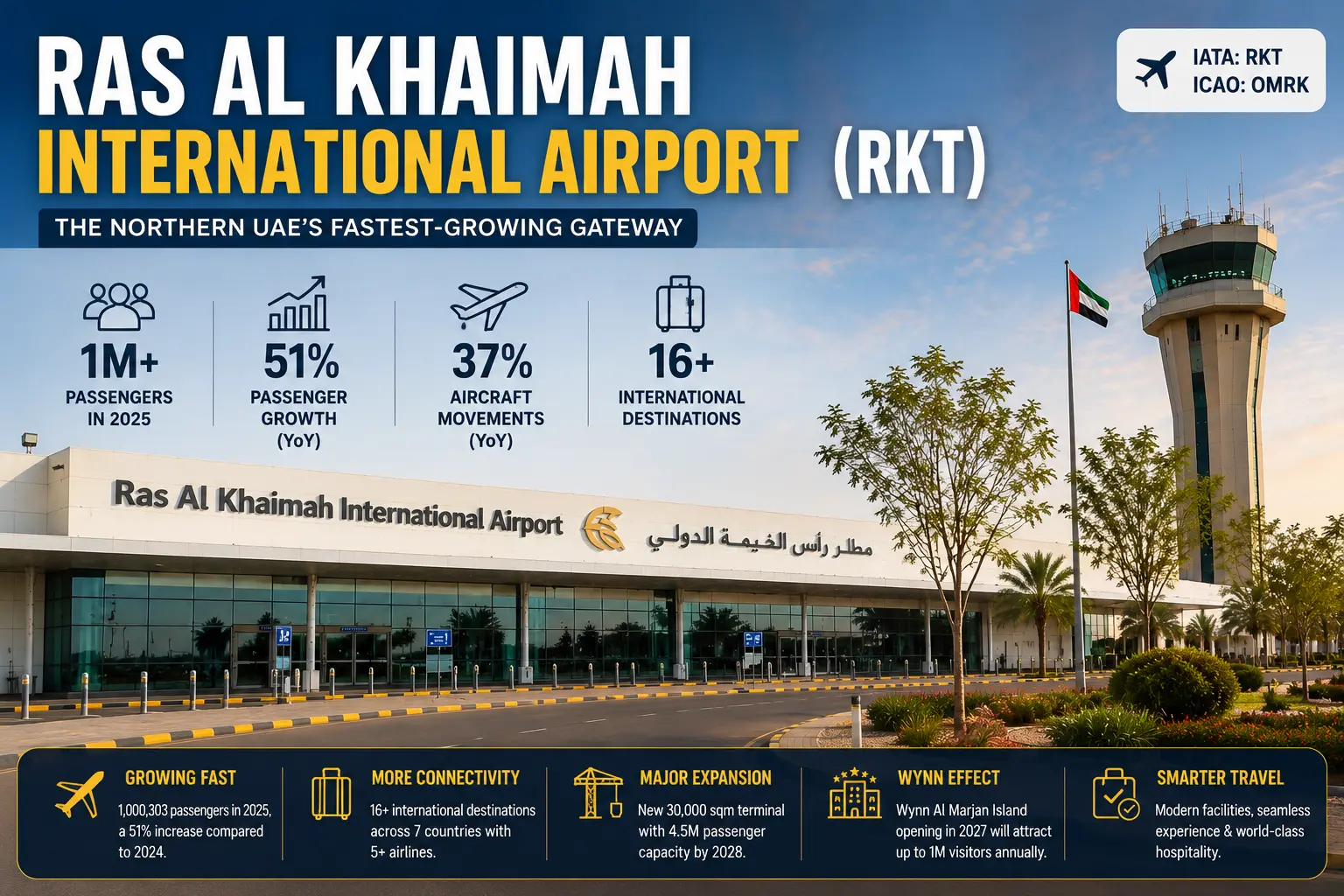
Ras Al Khaimah International Airport (RKT) is the fastest-growing airport in the UAE, surpassing the one-million-passenger milestone for the first time in 2025 with 1,000,303 travellers — a remarkable 51% year-on-year increase. The airport also recorded a 37% rise in flights and a 29.4% improvement in net profit, firmly positioning the northern emirate’s gateway in the medium-to-large airport category.
Established in 1976, RKT has undergone a dramatic transformation. After the collapse of its home carrier RAK Airways in 2014, the airport pivoted to a low-cost carrier model under a strategic partnership with Air Arabia. Today, the airport serves 16 international destinations across seven countries, with airlines including Air Arabia, IndiGo, and Air India Express connecting Ras Al Khaimah to India, Pakistan, Saudi Arabia, Russia, Egypt, and Central and Eastern Europe.
The airport’s growth trajectory is closely tied to Ras Al Khaimah’s broader tourism ambitions. The emirate welcomed 1.35 million overnight guests in 2025, up 6% from 2024, and is working toward a target of 3.5 million tourists annually by 2030. The opening of Wynn Al Marjan Island — the UAE’s first integrated casino resort, a $5.7 billion project scheduled for September 2027 — is expected to attract up to 1 million visitors per year, further accelerating demand for air connectivity.
A major expansion is underway, including a new 30,000 square metre terminal capable of handling 4.5 million passengers, a dedicated VVIP terminal for premium Wynn Al Marjan Island guests, and enhanced cargo facilities. This guide covers everything about Ras Al Khaimah International Airport: its history, current operations, expansion plans, the Wynn effect, airlines, and travel tips.
Quick Facts at a Glance
| Detail | Data |
| Official Name | Ras Al Khaimah International Airport |
| IATA Code | RKT |
| ICAO Code | OMRK |
| Arabic Name | مطار رأس الخيمة الدولي |
| Location | 18 km from Ras Al Khaimah city centre |
| Opened | 1976 |
| Operator | Ras Al Khaimah Department of Civil Aviation |
| Area | 5,255,012 sqm |
| Elevation | 31 meters (102 feet) above sea level |
| Runway | 16/34 — 3,760 m x 45 m (asphalt) |
| Terminals | 2 passenger terminals + new 30,000 sqm terminal (2028) |
| Current Capacity | ~1.2 million passengers/year |
| New Terminal Capacity | 4.5 million passengers/year |
| Passengers (2025) | 1,000,303 |
| Passenger Growth (2025) | +51% year-on-year |
| Aircraft Movements (2025) | +37% year-on-year |
| Cargo (2024) | 6,652 tonnes (+97% year-on-year) |
| Destinations | 16 international |
| Airlines | 5+ scheduled carriers |
| Hub Airline | Air Arabia (since 2014) |
| Phone | +971 7 207 5205 |
| Official Website | www.rakairport.com |
History of Ras Al Khaimah International Airport
Inauguration and Early Years (1976-2006)
Ras Al Khaimah International Airport was inaugurated in 1976 by His Highness Sheikh Saqr bin Mohammad Al Qasimi, the late Ruler of Ras Al Khaimah. The airport was established as a regional hub positioned midway between Europe and the Far East, functioning as the primary gateway connecting Ras Al Khaimah to global destinations.
Initially modest in scale, the airport featured basic infrastructure including a runway and terminal designed to support early aviation needs in the emirate. In its formative years through the 1990s, the airport concentrated on domestic flights within the UAE and a limited number of international routes, primarily serving regional connectivity. Passenger and cargo traffic remained modest, with the facility playing a supportive role in the local economy by facilitating trade and travel amid the emirate’s industrial development.
Operations faced challenges from low volumes, leading to heavy reliance on nearby Dubai International Airport for major international traffic. Key early milestones included the launch of initial commercial flights shortly after opening and the setup of basic cargo handling capabilities to accommodate growing local commerce.
RAK Airways Era (2007-2014)
In 2007, Ras Al Khaimah International Airport marked a significant milestone with the launch of RAK Airways as its home carrier, operating from the facility as a hub to connect the emirate to regional destinations. The airline’s operations were short-lived amid the global financial crisis, leading to a suspension of scheduled services in late 2008 after fleet reductions and financial strain.
Efforts to revive the carrier resulted in a relaunch in October 2010 as a low-cost operator with refreshed branding and management, aiming to bolster connectivity from the airport. However, persistent financial challenges culminated in the permanent cessation of operations on January 1, 2014.
Air Arabia Partnership and Growth (2014-Present)
Following the collapse of RAK Airways, the airport pivoted toward cargo operations to sustain activity, while securing a long-term strategic partnership with Air Arabia in February 2014. The low-cost carrier established RKT as its hub, and Ras Al Khaimah was designated as a hub for Air Arabia for a period of ten years, extendable thereafter.
This partnership proved transformative. Air Arabia launched commercial flights to destinations including Pakistan, Egypt, Saudi Arabia, and Bangladesh, significantly expanding the airport’s route network. The airport grew at 25% year-on-year in 2013 (albeit from a low base), and was refocused with efforts to attract cargo business, particularly from establishments under the Ras Al Khaimah Free Trade Zone.
In 2024, cargo throughput reached 6,652 tonnes, marking a 97% increase from the previous year and underscoring the facility’s growing importance for exports like electronics, textiles, pharmaceuticals, and perishable goods. The pivot toward cargo operations, accelerated since the mid-2010s with the opening of an advanced freight center in 2016, positioned the airport as a key logistics hub bridging Europe, Asia, and Africa.
Key Milestones
| Year | Milestone |
| 1976 | Airport inaugurated by Sheikh Saqr bin Mohammad Al Qasimi |
| 2007 | RAK Airways launches as home carrier |
| 2008 | RAK Airways suspends operations due to global financial crisis |
| 2010 | RAK Airways relaunches as low-cost carrier |
| 2014 | RAK Airways permanently ceases operations; Air Arabia establishes hub |
| 2016 | Advanced freight center opens for cargo operations |
| 2022 | Groundbreaking for Wynn Al Marjan Island resort |
| 2024 | 661,765 passengers; 6,652 tonnes cargo (+97%) |
| 2025 (Jun) | New 30,000 sqm terminal announced |
| 2025 (Sep) | Joby Aviation air taxi partnership announced |
| 2025 | 1,000,303 passengers — first time exceeding 1 million (+51%) |
| 2027 (Sep) | Wynn Al Marjan Island opens — UAE’s first casino resort |
| 2028 | New 30,000 sqm terminal expected to be operational |
Current Operations at RKT
Terminal Facilities
RKT currently operates two passenger terminal buildings: a Departure terminal (4,933 sqm) and an Arrival terminal (3,134 sqm). Combined, the existing terminals have a capacity of approximately 1.2 million passengers annually after refurbishment. The terminals feature check-in counters, immigration and customs facilities, duty-free shopping, restaurants, prayer rooms, and passenger lounges.
The airport operates 24 hours a day, 7 days a week, with full immigration, customs, air traffic control, and security services. It has an open skies policy with no restrictions on frequencies or time of arrival/departure, offering competitive tariffs and storage facilities.
Runway and Airside
RKT has one runway designated 16/34, measuring 3,760 meters (12,336 feet) in length and 45 meters (148 feet) in width with an asphalt surface. The runway is equipped with Precision Approach Category 1, Rescue and Fire Fighting Services Category 7, and is classified as ICAO Category 4E, capable of accommodating wide-body aircraft including the Boeing 777 and Airbus A330.
The main apron spans 115,550 square meters and has 19 aircraft parking positions. The airport does not plan to add a second runway despite the expansion, focusing instead on maximizing terminal capacity and operational efficiency.
Airlines and Destinations
RKT is served by five scheduled international airlines, connecting Ras Al Khaimah to 16 destinations across seven countries. The network has expanded rapidly, with new routes added to Jeddah, Moscow, Warsaw, Prague, and Tashkent in 2025 alone.
| Airline | Destinations | Type |
| Air Arabia | Cairo, Jeddah, Kozhikode, Moscow, Kazan, Tashkent, Islamabad, Kochi, Dhaka | Year-round (9 routes) |
| IndiGo | Hyderabad, Kochi, Mumbai | Year-round (3 routes) |
| Air India Express | Kannur, Lucknow, Kozhikode | Year-round (3 routes) |
| Smartwings | Prague | Seasonal |
| Gulf Wings | Various charter destinations | Charter |
Top Markets
The airport’s route network targets key markets:
- India — the largest source market, with routes to Kozhikode, Kochi, Hyderabad, Mumbai, Kannur, and Lucknow
- Pakistan — Islamabad and other cities via Air Arabia
- Saudi Arabia — Jeddah and other cities
- Russia — Moscow, Kazan, Tashkent, Yekaterinburg
- Egypt — Cairo
- Central and Eastern Europe — Prague, Warsaw, and other cities
Passenger Traffic
| Year | Passengers | Growth | Cargo (tonnes) | Cargo Growth |
| 2022 | ~400,000 | — | ~3,000 | — |
| 2023 | 517,000 | +29% | 3,370 | +12% |
| 2024 | 661,765 | +28% | 6,652 | +97% |
| 2025 | 1,000,303 | +51% | ~8,500 (est.) | +28% (est.) |
The airport has grown from handling approximately 400,000 passengers in 2022 to over 1 million in 2025 — a 150% increase in three years. This growth trajectory reflects the combined impact of Air Arabia’s network expansion, new airline entrants, and Ras Al Khaimah’s rising tourism appeal.
The Wynn Effect: How a Casino Resort is Transforming RKT
The single most significant factor shaping RKT’s future is the opening of Wynn Al Marjan Island, the UAE’s first integrated casino resort. The $5.7 billion (AED 20.9 billion) project, developed by Wynn Resorts (40% equity), Marjan, and RAK Hospitality Holding, is scheduled to open in September 2027 on Al Marjan Island, approximately 15 minutes from RKT.
Wynn Al Marjan Island at a Glance
| Detail | Data |
| Opening Date | September 2027 (confirmed August 2026) |
| Investment | $5.7 billion (AED 20.9 billion) |
| Height | 352 metres, 70 storeys — tallest structure in RAK |
| Total Keys | 1,530 (1,217 Resort + 313 Enclave) |
| Casino | 225,000 sq ft gaming floor — UAE’s first licensed casino |
| Restaurants & Bars | 22 venues |
| Pools | 12 pools |
| Convention Center | 7,708 sqm |
| Shopping | 12,000 sqm retail parterre |
| Marina | 98 berths |
| Beach | 550-metre shoreline with 3 beaches, lagoon, and reef |
| Distance from Dubai | ~45 minutes via Wynn Bridge (late 2026) |
| Jobs Created | 2,750+ in 2026; 4,000+ long-term roles |
Impact on Airport Traffic
Wynn Resorts expects up to 1 million visitors per year to the resort, with many making multiple trips annually. Airport CEO Manish Seth has set a target of 1.5 million passengers by the end of 2027, partly driven by the Wynn opening. Ras Al Khaimah authorities expect total visitor numbers to reach approximately 4.6 million in 2027, including an estimated 1.5 million tourists from other UAE emirates.
“The endeavour… is to achieve the same feat in the next two years,” Seth told AGBI, referring to the 50% passenger growth achieved in 2024-2025. “That will help us build traffic,” he added, referring to Wynn Al Marjan Island’s impact.
VVIP Terminal
To support premium traffic linked to Wynn Al Marjan Island, RKT is developing a dedicated VVIP terminal in partnership with Falcon Executive Aviation. The facility will feature a Royal lounge, four VVIP lounges, and premium hospitality areas designed for discreet, high-profile passengers.
The VVIP terminal will include:
- A 1,500 square metre terminal building
- An 8,000 square metre multi-purpose hangar
- 9,000 square metres of apron and aircraft parking
- A Royal lounge and four VVIP lounges
- Premium hospitality areas
The terminal is expected to open in 2027, coinciding with the Wynn Al Marjan Island opening.
30,000 Sqm Terminal Expansion
In June 2025, Ras Al Khaimah International Airport launched a major terminal development project, adding a new 30,000 square metre facility to complement the existing Departure (4,933 sqm) and Arrival (3,134 sqm) terminals. Led by Sheikh Salem bin Sultan Al Qasimi, Chairman of the Department of Civil Aviation and the Airport’s Board, the project is a strategic step toward establishing Ras Al Khaimah as a key aviation and tourism hub in the UAE.
New Terminal Features
- Advanced baggage handling systems
- Electronic gates for faster processing
- Upgraded security screening
- Automated check-in facilities
- Smart technology integration
- Sustainability features including LED lighting and geothermal heat pumps
- Capacity to handle up to 4.5 million passengers annually
Capacity Phasing
The expansion is being phased to manage growth:
- Phase 1 (current): Refurbish existing terminal to handle 1.2 million passengers
- Phase 2 (2027): Open VVIP terminal for Wynn Al Marjan Island guests
- Phase 3 (2028): Open new 30,000 sqm terminal with 4.5 million passenger capacity
Despite the expansion, the airport does not plan to add a second runway, focusing instead on maximizing terminal capacity and operational efficiency.
Sustainability and Innovation
RKT has emerged as a pioneer in sustainable aviation practices in the Middle East. In 2025, it became the first airport in the Middle East and Asia to adopt advanced thermodynamic energy optimization cooling technology from DYNAES, enhancing sustainability efforts. The system contributes to emissions reductions, with potential global applications estimated to cut CO₂ by up to 7% in similar sectors.
Green Initiatives
- Integration of LED lighting throughout the terminal
- Geothermal heat pump systems for heating and cooling
- Water recycling programs
- DYNAES thermodynamic energy systems
- Electric ground vehicle fleet
- Carbon offset programs supporting UAE’s aviation decarbonization goals
- Waste management aligned with RAK’s Integrated Sustainability Strategy 2050
Advanced Air Mobility
In September 2025, Ras Al Khaimah Transport Authority partnered with Joby Aviation and Skyports to launch all-electric air taxi services by 2027. The service will connect key sites including Al Marjan Island, Al Hamra, and Jebel Jais to the airport, using zero-emission aircraft to reduce noise and emissions while enhancing tourism accessibility. This positions Ras Al Khaimah as a hub for advanced air mobility in the UAE.
Drone Management
In 2025, RKT implemented an advanced Drone Management System, becoming one of the first airports in the UAE to integrate drone detection and management technology into its operations. The system enhances safety and security while supporting the growing drone ecosystem in the region.
RKT vs DXB vs SHJ: How Ras Al Khaimah Compares
| Feature | RKT (Ras Al Khaimah) | DXB (Dubai) | SHJ (Sharjah) |
| Location | RAK, 18 km from city | Dubai, 4.6 km from city | Sharjah, 13 km from city |
| Passengers (2025) | 1,000,303 | 95.2 million | 19.48 million |
| Growth (2025) | +51% | +5% | +13.9% |
| Hub Airline | Air Arabia | Emirates | Air Arabia |
| Runways | 1 | 2 | 1 |
| Runway Length | 3,760 m | 4,000 m x 2 | 4,060 m |
| Terminals | 2 (+ new 30,000 sqm) | 3 | 1 |
| Destinations | 16 | 260+ | 80+ |
| Airlines | 5+ | 120+ | 20+ |
| Unique Feature | Wynn casino resort | Concourse A | Budget hub |
| Open Skies Policy | Yes | No | Yes |
Getting to and from RKT
RKT is located approximately 18 kilometers from Ras Al Khaimah city centre. The airport is also accessible from Dubai (approximately 100 km, 1-1.5 hours) and Sharjah (approximately 80 km, 1 hour).
Taxi and Rideshare
Taxis and ride-hailing services (Uber, Careem) are available at the airport. The ride to Ras Al Khaimah city centre takes approximately 15-20 minutes, while the ride to Dubai takes approximately 1-1.5 hours depending on traffic.
Airport Shuttle
RKT offers dedicated airport shuttle services to major hotels and resorts in Ras Al Khaimah, providing convenient connections for tourists and business travellers.
Car Rental
All major car rental companies are available at the airport. RKT is well connected to the E311 and E611 highways, providing easy access to Dubai, Sharjah, and other emirates.
Future: Wynn Bridge
The 548-metre Wynn Bridge, due to open in late 2026, will connect Al Marjan Island directly to the E311 and E611 highways via the new Wynn Boulevard. This will reduce travel time from Dubai to approximately 45 minutes and provide improved access to RKT from the south.
Transport Comparison
| Mode | Cost to RAK City | Cost to Dubai | Travel Time |
| Taxi/Uber | AED 20-30 | AED 100-150 | 15-20 min / 1-1.5 hrs |
| Shuttle | AED 15-25 | AED 80-120 | 20-30 min / 1-1.5 hrs |
| Car Rental | Varies | Varies | 15-20 min / 1-1.5 hrs |
Facilities and Services
Terminal Amenities
- Duty-free shopping with perfumes, electronics, and confectionery
- Currency exchange and banking services
- Prayer rooms for men and women
- Free Wi-Fi throughout the terminal
- Information desks with multilingual staff
- ATMs and cash machines
- Left luggage and baggage wrapping services
- Car rental desks
- Passenger lounges
Cargo Facilities
RKT has dedicated cargo facilities including two cargo terminals and an advanced freight center that opened in 2016. The airport handled 6,652 tonnes of cargo in 2024, a 97% increase year-on-year. Cargo services include warehousing, freight forwarding, customs brokerage, and ground transportation, catering to general cargo, perishable goods, and dangerous goods.
Aircraft Maintenance and Training
The airport offers aircraft maintenance services and aviation training facilities, supporting the wider aviation industry in the northern UAE. These services include technical support for airlines and the development of skilled aviation professionals.
Hotels Near RKT
Several hotels are located in Ras Al Khaimah city and along the coastline:
- Wynn Al Marjan Island — opening September 2027 (1,530 keys)
- Jumeirah Al Wathba Desert Resort & Spa
- Hilton Ras Al Khaimah Beach Resort
- The Ritz-Carlton Ras Al Khaimah, Al Wadi Desert
- Marjan Island Resort & Spa
- DoubleTree by Hilton Resort & Spa Al Marjan Island
- BM Beach Resort
Nearby Attractions
Ras Al Khaimah offers unique attractions:
- Jebel Jais — the UAE’s highest peak at 1,934 metres, home to the world’s longest zipline
- Al Marjan Island — coral-shaped artificial islands with beaches and resorts
- Dhayah Fort — historic hilltop fort with panoramic views
- Jazirat Al Hamra — abandoned pearl fishing village
- Suwaidi Pearls — pearl diving experience
- Wynn Al Marjan Island — UAE’s first casino resort (opening September 2027)
Tips for Travelers
Fly RKT for faster access to Ras Al Khaimah. RKT is much closer to Ras Al Khaimah than Dubai or Sharjah airports. If you’re visiting the emirate, flying directly to RKT saves significant travel time.
Compare prices with DXB and SHJ. RKT is served by low-cost carriers like Air Arabia and IndiGo, which often offer competitive fares. Compare prices with Dubai and Sharjah before booking.
Use RKT as an alternative to Dubai. If you’re visiting northern Ras Al Khaimah or the Hajar Mountains, RKT is more convenient than flying into Dubai and driving north.
Check seasonal routes. Some routes from RKT are seasonal, operating only during peak travel periods (November-March). Verify flight availability before booking.
Book car rental in advance. Ras Al Khaimah is less densely populated than Dubai, and public transport options are limited. Renting a car is the best way to explore the emirate.
Plan for Wynn Al Marjan Island. When the casino resort opens in September 2027, expect increased demand and potentially higher fares. Book flights and accommodation well in advance.
Explore Jebel Jais. Take the world’s longest zipline or drive to the UAE’s highest peak for stunning mountain views. The drive from RKT takes approximately 45 minutes.
FAQ
What is Ras Al Khaimah International Airport?
Ras Al Khaimah International Airport (RKT) is an international airport located 18 km from Ras Al Khaimah city centre in the northernmost emirate of the UAE. Opened in 1976, it handled 1,000,303 passengers in 2025, a 51% year-on-year increase.
How many passengers does RKT handle?
RKT handled 1,000,303 passengers in 2025, surpassing the one-million milestone for the first time. The airport aims to reach 1.5 million passengers by 2027.
Which airlines fly from RKT?
RKT is served by Air Arabia (primary hub), IndiGo, Air India Express, Smartwings, and Gulf Wings, connecting to 16 international destinations across India, Pakistan, Saudi Arabia, Russia, Egypt, and Central/Eastern Europe.
What is the Wynn Al Marjan Island impact?
Wynn Al Marjan Island, the UAE’s first casino resort ($5.7 billion), opens in September 2027 and is expected to attract up to 1 million visitors per year, significantly boosting airport traffic.
What are the expansion plans for RKT?
RKT is building a new 30,000 sqm terminal (4.5 million passenger capacity, opening 2028) and a dedicated VVIP terminal for Wynn guests (opening 2027). The existing terminal is being refurbished to handle 1.2 million passengers.
Is RKT closer to Dubai than DXB?
RKT is approximately 100 km from Dubai (1-1.5 hours drive). DXB is obviously closer for Dubai-bound travelers, but RKT is more convenient for Ras Al Khaimah and northern emirates.
What is the runway length at RKT?
RKT has a 3,760-meter (12,336-foot) asphalt runway, capable of accommodating wide-body aircraft including the Boeing 777 and Airbus A330.
Does RKT handle cargo?
Yes. RKT handled 6,652 tonnes of cargo in 2024, a 97% increase year-on-year. The airport has two cargo terminals and an advanced freight center.
Are there air taxis at RKT?
RKT has partnered with Joby Aviation and Skyports to launch all-electric air taxi services by 2027, connecting key sites including Al Marjan Island and Jebel Jais.