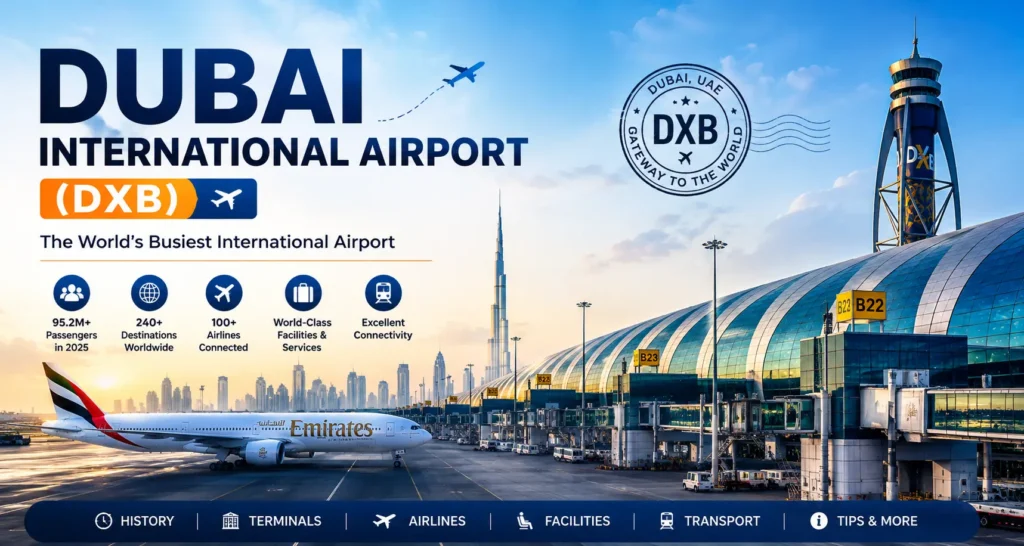
Dubai International Airport (DXB) is not just an airport. It is a machine that moves more international passengers than any other facility on Earth. In 2025, DXB welcomed 95.2 million travelers, a 3.1% increase over the previous year and the highest annual international passenger traffic ever recorded by any airport globally. The airport has held the number one position for international passenger traffic since 2014, an unbroken streak that now spans over a decade.
The numbers alone tell a story of scale that is hard to comprehend. DXB handled 454,800 flight movements in 2025, processed 86.75 million bags, and connected passengers to more than 240 destinations across six continents through nearly 100 airlines. The airport sits on 2,900 hectares of land in the Al Garhoud district, just 4.6 kilometers east of Dubai’s city center, and its two parallel runways can sustain over 90 landings and takeoffs per hour during peak periods.
What makes DXB genuinely remarkable is not just the volume but the consistency. December 2025 was the busiest month in the airport’s history, with 8.7 million guests. The fourth quarter set a record too, with 25.1 million guests. These are not isolated spikes. DXB now operates continuously at the edge of its physical capacity and treats record traffic as normal operating rhythm.
For travelers, aviation professionals, and anyone trying to understand how modern mega-airports function, DXB offers a case study in infrastructure, logistics, and ambition. This guide covers everything about the airport: its history, terminals, airlines, facilities, transport connections, and what comes next.
Quick Facts at a Glance
| Detail | Data |
| IATA Code | DXB |
| ICAO Code | OMDB |
| Location | Al Garhoud, Dubai, UAE |
| Distance from City Center | 4.6 km (2.9 miles) east |
| Area | 2,900 hectares (7,200 acres) |
| Elevation | 19 meters above sea level |
| Annual Capacity | 115 million passengers |
| Terminals | 3 (Terminal 1, Terminal 2, Terminal 3) |
| Concourses | 4 (Concourse A, B, C, D) |
| Runways | 2 parallel (each 4,000 meters) |
| Airlines | ~100 |
| Destinations | 240+ across 6 continents |
| 2025 Passengers | 95.2 million |
| 2024 Flight Movements | 444,126 |
| Cargo Handled (2024) | 2.20 million tons |
| Official Website | dubaiairports.ae |
| Phone | +971 4 224 5555 |
History of Dubai International Airport
From Sand Runway to Global Mega-Hub
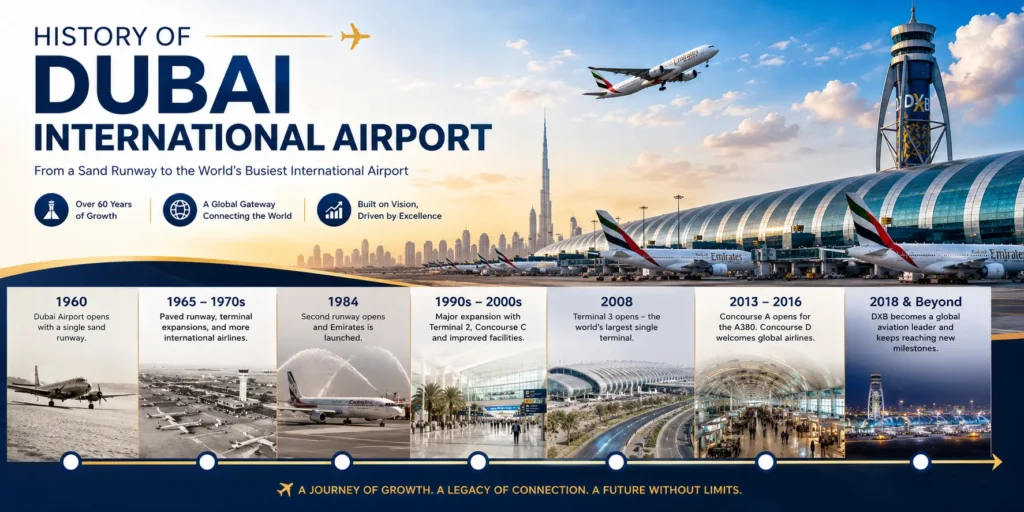
The story of DXB begins in 1959, when work started on building an airport on a stretch of wasteland about 4 kilometers from what was then the edge of Dubai. On September 30, 1960, the airport opened with a single runway made of compacted sand, capable of receiving aircraft up to the size of a Douglas DC-3. The airport served mainly as a refueling stop for planes flying between Europe and Asia.
The 1960s brought incremental improvements. In 1963, construction began on an asphalt runway, which opened in 1965 along with terminal extensions and new hangars. By 1969, the airport was served by 9 airlines flying to approximately 20 destinations.
The real transformation came during the 1970s and 1980s, driven by Dubai’s leadership and their vision of turning the emirate into a global crossroads. A new three-story terminal building, a control tower, additional taxiways, and improved landing systems were added. In 1984, a second runway opened with Category II instrument landing capabilities, allowing operations in low-visibility conditions. That same year, Emirates airline was launched from DXB, a decision that would fundamentally reshape the airport’s trajectory.
The 1990s and 2000s saw a series of major expansion projects. Terminal 2 opened in 1998, adding 2 million passengers to the airport’s annual capacity. In 2000, Concourse C (originally called Concourse 1) opened, increasing total capacity from 10 million to 23 million passengers. Terminal 3, dedicated exclusively to Emirates, opened in 2008 and held the record as the largest single terminal in the world, pushing capacity to 60 million.
Concourse A, the world’s largest purpose-built facility for the Airbus A380, opened in 2013. In 2016, Concourse D, a $1.2 billion facility serving 70+ international airlines, became operational. By 2018, DXB welcomed its one billionth cumulative passenger.
In 2014, DXB surpassed London Heathrow as the world’s busiest airport for international passenger traffic and has not relinquished that position since. By 2023, DXB also became the second busiest airport in the world overall (after Atlanta Hartsfield-Jackson), moving up five places from its 2022 ranking.
Timeline of Key Milestones
| Year | Milestone |
| 1960 | Airport opens with a single compacted sand runway |
| 1965 | First asphalt runway and terminal extensions completed |
| 1984 | Second runway opens; Emirates airline founded |
| 1998 | Terminal 2 opens, adding 2 million annual capacity |
| 2000 | Concourse C opens, capacity rises to 23 million |
| 2008 | Terminal 3 opens, capacity reaches 60 million |
| 2013 | Concourse A (A380 facility) opens; DWC opens to passengers |
| 2014 | DXB becomes world’s busiest airport for international passengers |
| 2016 | Concourse D opens at a cost of $1.2 billion |
| 2018 | One billionth passenger welcomed |
| 2024 | 92.3 million passengers, highest in 65-year history |
| 2025 | 95.2 million passengers, highest annual international traffic ever recorded |
Terminals and Concourses
DXB operates three passenger terminals and four concourses. Each serves a different mix of airlines and passenger types.
Terminal 1
Terminal 1 is the general-purpose terminal, used by over 100 international airlines. It has a capacity of 45 million passengers annually and covers 520,000 square meters with 221 check-in counters. The terminal is connected to Concourse D via an automated people mover (APM) that moves up to 300 passengers per trip with a 2-3 minute transit time and a capacity of 7,000 passengers per hour in each direction.
Terminal 1 originally opened in 1971 as a three-story building with VIP lounges and piers. It has been renovated multiple times and now features modern retail, dining, and lounge facilities.
Terminal 2
Terminal 2 handles regional and low-cost carriers, most notably flydubai. It was opened in 1998 and has a capacity of 10 million passengers annually with 37 check-in counters. Over 50 airlines use Terminal 2 for short-haul and point-to-point services, particularly to the Indian subcontinent and the Persian Gulf region.
Terminal 2 is located separately from Terminals 1 and 3 and can be reached by free shuttle buses, which take approximately 20 minutes to reach Terminal 1 and 30 minutes to reach Terminal 3. The terminal was upgraded to accommodate flydubai’s growth and now features 15,000 solar panels on its roof, the region’s largest airport solar installation.
Terminal 3
Terminal 3 is the crown jewel of DXB and one of the largest airport terminal structures in the world. It is used exclusively by Emirates and is divided into three concourses:
Concourse A – Opened in 2013, this is the world’s largest purpose-built facility for the Airbus A380. It handles Emirates’ long-haul flights to destinations across North America, Europe, and Australasia.
Concourse B – The historic heart of Emirates operations at DXB, handling intercontinental flights with extensive duty-free, dining, and spa facilities.
Concourse C – Used by Emirates and partner airlines, hosting numerous international gates with consistent service quality.
Terminal 3 features multiple first and business class lounges, the DXB Hotel (airside accommodation requiring no immigration clearance), direct-access premium boarding, and one of the world’s largest duty-free retail operations.
Concourse D
Concourse D opened in 2016 at a cost of $1.2 billion and serves over 70 international airlines through Terminal 1. It includes 17 gates and is connected to Terminal 1 via the automated people mover. Concourse D was designed to handle the overflow of non-Emirates carriers and has its own retail, dining, and lounge areas.
Airlines and Destinations
Emirates
Emirates is the backbone of DXB’s connectivity. The airline operates a fleet composed primarily of Airbus A380s and Boeing 777s, connecting Dubai to over 150 destinations across six continents. Emirates carried 51% of all passengers at DXB in 2024. The airline’s route network spans major cities in Europe, North America, South America, Asia, Africa, and Australasia.
Emirates has exclusive access to Concourses A, B, and C within Terminal 3. The airline’s hub-and-spoke model at DXB allows passengers from smaller cities across its network to connect through Dubai to virtually anywhere in the world.
flydubai
flydubai is Dubai’s low-cost carrier and complements Emirates’ long-haul network with short to medium-haul services. The airline operates from Terminal 2 and connects Dubai to destinations across the Middle East, South Asia, Africa, and Eastern Europe. flydubai carried approximately 13% of DXB’s passengers in 2024.
Other Airlines
Nearly 100 airlines operate from DXB, including major international carriers such as British Airways, Lufthansa, Air France, KLM, Qantas, Singapore Airlines, Cathay Pacific, Turkish Airlines, Ethiopian Airlines, South African Airways, American Airlines, Air India, and Pakistan International Airlines.
Top Country Markets (2024 Arrivals)
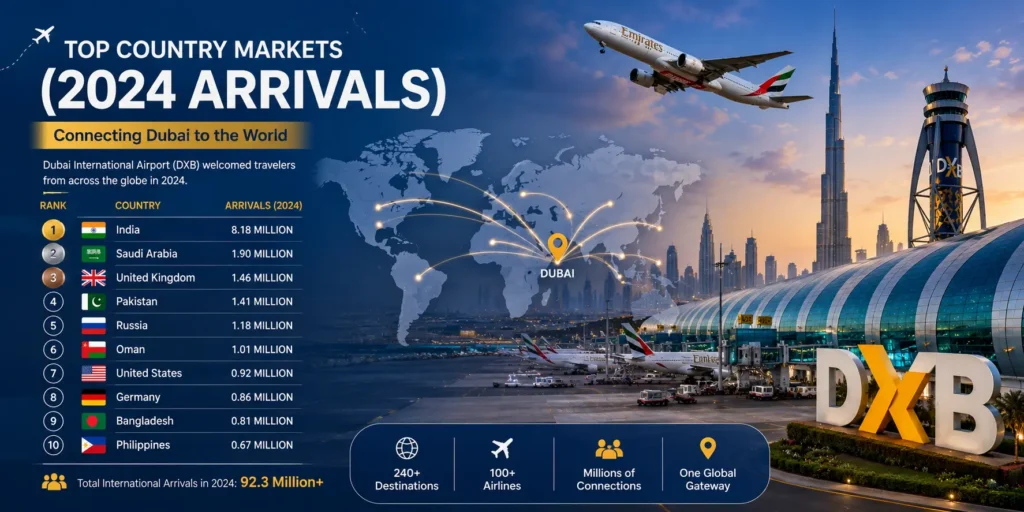
| Rank | Country | Passengers |
| 1 | India | 5.36 million |
| 2 | Saudi Arabia | 3.63 million |
| 3 | United Kingdom | 2.96 million |
| 4 | Pakistan | 2.23 million |
| 5 | United States | 1.70 million |
| 6 | Russia | 1.66 million |
| 7 | Germany | 1.34 million |
| 8 | Australia | 1.08 million |
| 9 | Turkey | 1.08 million |
| 10 | Thailand | 972,858 |
Top Destinations by Passenger Volume
| Rank | City | Passengers |
| 1 | London | 3.7 million |
| 2 | Riyadh | 2.6 million |
| 3 | Mumbai | 2.5 million |
Passenger Traffic Statistics
DXB’s passenger growth has been one of the most dramatic stories in aviation history. The airport went from handling 18 million passengers in 2003 to over 95 million in 2025.
Annual Passenger Numbers
| Year | Passengers | Notes |
| 2003 | 18 million | ACI ranks DXB second fastest growing airport |
| 2008 | 37.5 million | Terminal 3 opens |
| 2009 | 40 million | DXB becomes world’s fastest growing airport |
| 2013 | 66.4 million | Concourse A opens |
| 2014 | 70.4 million | Becomes world’s busiest international airport |
| 2018 | 89.1 million | One billionth passenger welcomed |
| 2019 | 86.4 million | Pre-pandemic peak |
| 2020 | 25.9 million | COVID-19 impact |
| 2021 | 29.1 million | Recovery begins |
| 2022 | 66.1 million | Strong recovery |
| 2023 | 87.0 million | Surpasses pre-pandemic levels |
| 2024 | 92.3 million | Highest in 65-year history |
| 2025 | 95.2 million | Highest annual international traffic ever recorded |
Flight Movements
| Year | Movements | Notes |
| 2019 | 376,598 | Pre-pandemic |
| 2020 | 184,713 | Pandemic low |
| 2021 | 236,515 | Recovery |
| 2023 | 416,405 | Up 21.3% year-on-year |
| 2024 | 444,126 | Up 5.5% year-on-year |
| 2025 | 454,800 | Up 3.3% year-on-year |
Cargo Volume
| Year | Cargo (million tons) | Notes |
| 2019 | 2.38 | Pre-pandemic |
| 2020 | 1.84 | Pandemic impact |
| 2023 | 2.11 | Recovery |
| 2024 | 2.20 | Up 4.3% year-on-year |
DXB ranks among the top 10 international cargo hubs globally, with an annual cargo handling capacity of 3.3 million tonnes.
Runways and Airfield Infrastructure
DXB operates two parallel runways, each 4,000 meters (13,123 feet) in length. The runways are positioned to allow simultaneous departure and arrival operations, which is critical for sustaining the airport’s high movement rate during peak periods.
The runways are equipped with high-speed exit taxiways that reduce runway occupancy times, a measurable factor in DXB’s ability to handle approximately 90+ landings and takeoffs per hour during peak operations. The air traffic control tower uses advanced radar and predictive sequencing software that enables precise aircraft spacing on final approach.
DXB completed a southern runway resurfacing project in 2019, and the northern runway underwent refurbishment in 2022. These projects are scheduled during low-traffic windows to minimize disruption to operations.
The airport’s A380 infrastructure required $230 million in modifications, including 29 gates capable of handling large aircraft (five in Terminal 3 and two in Terminal 1).
Facilities and Services
Dubai Duty Free
Dubai Duty Free (DDF) operates across more than 38,000 square meters of retail space at DXB, making it one of the largest duty-free operations in the world. DDF generated over $1.93 billion in revenue in 2017 and has continued to grow. Key product categories include perfumes and cosmetics, electronics, designer fashion, fine jewelry and watches, tobacco, and spirits.
The Dubai Duty Free Millennium Millionaire promotion is an ongoing draw, offering major cash prizes to passengers who purchase tickets at the airport.
Lounges
DXB offers a wide range of lounge options across its terminals, from airline-operated first and business class lounges to independent pay-per-use facilities.
| Lounge | Terminal/Concourse | Hours | Rating |
| Ahlan Lounge at B | T3 Concourse B | 24h | 4.3/5 |
| Marhaba Lounge | T3 Concourse B | 24h | 3.8/5 |
| Ahlan Lounge | T3 Concourse A | 24h | 4.0/5 |
| Plaza Premium Lounge | T3 Concourse A | 24h | 4.1/5 |
| Ahlan Lounge @C13 | T3 Concourse C | 24h | 4.2/5 |
| Ahlan Business Class Lounge | T1 Concourse D | 24h | 4.4/5 |
| SkyTeam Lounge | T1 Concourse D | 02:00-20:00 | 4.4/5 |
| Marhaba Lounge | T1 Concourse D | 24h | 3.8/5 |
Lounge access typically includes complimentary food, alcoholic and non-alcoholic beverages, high-speed Wi-Fi, comfortable seating, and shower facilities in select lounges. Prices for pay-per-use lounges range from approximately AED 90 (Plaza Premium) to higher amounts for private suites and extended stays.
Hotels
The DXB Hotel is located within Terminal 3’s transit area and offers airside accommodation without requiring immigration clearance. This makes it convenient for transit passengers and crew on long layovers. Rooms range from standard to suite level, with soundproofing, a fitness center, pool, and spa.
For landside accommodation, the Premier Inn Dubai International Airport provides budget-friendly rooms with a free shuttle to Terminals 1 and 3.
Dining
Over 100 food and beverage outlets operate across DXB’s three terminals. Options range from 24-hour fast food to sit-down restaurants with full international menus. Halal food options are available across all terminals, and vegetarian and vegan menus are widely offered. Facilities run continuously with no dead period, which matters for crew and passengers operating on irregular schedules.
Wi-Fi and Connectivity
DXB provides complimentary Wi-Fi across all three terminals with no time limit. Connection speed is generally sufficient for video calls and document work, making it a workable option for business passengers during layovers.
Other Services
- Prayer rooms in all terminals
- Zen Gardens for relaxation
- Art installations that rotate through the terminals
- Biometric technologies for passport control
- Pharmacies and medical services
- Currency exchange and banking (Al Ansari Exchange, Travelex, and others)
- Baggage wrapping and luggage storage
- Family services and play zones
- Accessibility services for passengers with disabilities
Getting to and from DXB
Dubai Metro
The Dubai Metro Red Line serves DXB with stations at Terminal 1 and Terminal 3. Trains run approximately every 10 minutes. Operating hours are:
- Monday to Thursday: 5:00 AM to 12:00 AM
- Friday: 5:00 AM to 1:00 AM (next day)
- Saturday: 5:00 AM to 12:00 AM
- Sunday: 8:00 AM to 12:00 AM
You need a Nol Card (Dubai’s smart transit card) to use the Metro. Cards can be purchased and topped up at Metro station kiosks using cash or credit/debit cards. Fares are calculated based on the number of zones crossed and typically range from AED 5 to AED 8.5 for a standard class trip.
Taxi
Dubai Taxi Company (DTC) taxis are available 24/7 at designated ranks in each terminal. The airport base fare starts at AED 25. Taxis can reach downtown Dubai in approximately 20 minutes depending on traffic. Uber and Careem (the regional ride-hailing app) also operate from DXB, with pickup areas at each terminal.
Bus
Regular buses connect DXB with various parts of Dubai via the Ibn Batutta metro station. Free shuttle buses also operate continuously between terminals.
Car Rental
Car rental agencies are available at all terminals. Driving in Dubai requires an international driving permit for most visitors.
Terminal Transfers
Free shuttle buses run between terminals. The ride from Terminal 2 to Terminal 1 takes approximately 20 minutes, and to Terminal 3 approximately 30 minutes. Inside the terminals, an automated people mover connects Terminal 1 with Concourse D.
Transportation Cost Comparison
| Mode | Cost to Downtown | Travel Time | Availability |
| Metro | AED 5-8.5 | 25-30 minutes | 5 AM – midnight |
| Taxi | AED 50-70 | 20-40 minutes | 24/7 |
| Uber/Careem | AED 40-60 | 20-40 minutes | 24/7 |
| Bus | AED 3-5 | 30-45 minutes | 24/7 |
Economic Impact
DXB is a major economic engine for Dubai and the wider UAE. The airport supports thousands of jobs directly and indirectly and generates billions in revenue through aviation, tourism, and retail activities.
The aviation sector contributes significantly to Dubai’s GDP. The airport’s role as a global transit hub means that millions of passengers pass through Dubai annually, spending on hotels, restaurants, attractions, and retail. Dubai Duty Free alone generates over $2 billion in annual revenue, making it one of the most profitable airport retail operations in the world.
The airport also plays a critical role in Dubai’s tourism strategy. The emirate welcomed over 17 million international overnight visitors in 2023, and many of those visitors arrived through DXB. The airport’s connectivity to over 240 destinations makes it a natural gateway for tourists from Europe, Asia, Africa, and the Americas.
Sustainability Initiatives
Dubai Airports has implemented several sustainability programs at DXB:
- Solar energy: A 15,000-panel solar array on Terminal 2’s roof, the region’s largest airport solar installation
- LED lighting: Energy-efficient LED lighting deployed across all terminals
- Electric vehicles: Electric and hybrid ground vehicle program
- Carbon reduction: Target of 20% reduction in carbon footprint (achieved Level 3 of ACI’s Airport Carbon Accreditation Programme in 2019)
- Baggage handling: 89% of arriving bags delivered to guests within 45 minutes of the aircraft arriving on stand
Future Plans and Expansion
DXB Expansion
Dubai Airports CEO Paul Griffiths has unveiled plans for a 6-10 billion AED ($1.63-2.72 billion) expansion and makeover of DXB over the next seven years. This project includes:
- Increasing the number of check-in desks
- Adding new lounges
- Installing new security scanners that do not require removing liquids
- Introducing smart technology across the operation
- Creating better circulation areas with consolidated restaurant and seating zones
DXB currently has a capacity of 115 million passengers annually. This is set to grow to over 120 million through ongoing process enhancement programs designed to elevate efficiency and guest experience.
The 2026 forecast is 99.5 million passengers, putting DXB on track to approach the 100 million mark for the first time.
Al Maktoum International Airport (DWC)
In April 2024, Sheikh Mohammed Bin Rashid Al Maktoum approved a AED 128 billion Phase 2 expansion of Al Maktoum International Airport (DWC), located approximately 75 kilometers south of DXB. The expansion plans include:
- Capacity: 150 million passengers annually in the first phase, eventually reaching 260 million
- Runways: Five runways, four operating independently
- Terminals: West and East processing terminals with four satellite concourses
- Gates: Over 400 aircraft contact stands
- Cargo: 12 million tonnes annually
The full build-out timeline extends to 2057. Eventually, all major operations including Emirates will migrate from DXB to DWC, which will become the world’s largest airport. However, this transition is not expected before the mid-2030s.
Until then, DXB will continue to serve as Dubai’s primary aviation hub, with ongoing investments to maximize its remaining capacity.
Tips for Travelers
Check your terminal. DXB has three terminals that are not physically connected landside. Terminal 2 is separate from Terminals 1 and 3, and shuttle buses are required for transfers. Confirm your airline’s terminal before arriving.
Arrive early. DXB is busy. Check-in opens 3-4 hours before international departures for most carriers. Security and passport control queues can be long during peak hours, though 95% of departing passengers clear passport control in under 7 minutes.
Use the Metro. The Red Line connects directly to Terminals 1 and 3. It is the cheapest and often fastest way to reach downtown Dubai. Buy a Nol Card before boarding.
Explore the duty-free. Dubai Duty Free is one of the world’s largest airport retail operations. Even if you are not planning to buy, the sheer scale of the offering is worth a look during a layover.
Consider a lounge. If you have a long layover, pay-per-use lounges are available in all terminals. Prices start around AED 90 for basic access.
Download the DXB app. The Dubai Airports app provides real-time flight information, terminal maps, and dining and retail directories.
Stay connected. Free Wi-Fi is available throughout the airport with no time limit.
Know your transport options. Metro, taxi, Uber, and Careem are all available. Metro is cheapest; taxi or ride-hailing is most convenient for door-to-door service.
Limitations
DXB is not without its constraints. The airport operates near maximum capacity during peak periods, and slot restrictions mean that not all airlines that want to operate from DXB can do so. The airport’s urban location, within 9 kilometers of downtown Dubai, limits physical expansion options.
Terminal 2’s relative isolation from Terminals 1 and 3 creates inconvenience for passengers transferring between carriers. The 20-30 minute shuttle ride between terminals adds time to connecting itineraries.
During the 2014 runway resurfacing project, DXB operated with a single runway for 80 days, reducing flight capacity by 26% and forcing 14 airlines to temporarily relocate to Al Maktoum International Airport. Emirates cut 5,000 flights and grounded over 20 aircraft during that period. Similar disruptions occurred during the 2019 and 2022 runway closures, though for shorter durations.
The ongoing expansion of Al Maktoum International Airport raises long-term questions about DXB’s future role, though the transition is still at least a decade away.
Conclusion
Dubai International Airport has evolved from a sand runway in 1960 to the world’s busiest hub for international passengers. In 2025, it handled 95.2 million travelers and set records across every metric: busiest day, busiest month, busiest quarter, and busiest year. These records are no longer exceptions but part of the airport’s normal operating reality.
For travelers, DXB offers a combination of connectivity, facilities, and services that few airports can match. With over 240 destinations, world-class duty-free, multiple lounge options, free Wi-Fi, and direct Metro access, the airport is designed to handle massive volumes while maintaining a quality passenger experience.
The next chapter for Dubai’s aviation story involves Al Maktoum International Airport and its planned capacity of 260 million passengers. But for now, DXB remains the center of gravity, and its trajectory suggests it will continue to set the pace for international aviation for years to come.
FAQ
How many passengers does Dubai International Airport handle annually?
DXB handled 95.2 million passengers in 2025, making it the world’s busiest airport for international passenger traffic for the 11th consecutive year. The airport’s annual capacity is 115 million passengers, with plans to expand to over 120 million.
Which terminal does Emirates operate from at DXB?
Emirates operates exclusively from Terminal 3, which is divided into three concourses: Concourse A (A380 operations), Concourse B (intercontinental flights), and Concourse C (Emirates and partner airlines). Terminal 3 is one of the largest airport terminal structures in the world.
How do I get from DXB to downtown Dubai?
The Dubai Metro Red Line connects directly to Terminals 1 and 3, with trains running every 10 minutes. The journey to downtown Dubai takes approximately 25-30 minutes and costs AED 5-8.5 with a Nol Card. Taxis and ride-hailing services (Uber, Careem) are also available 24/7, with fares starting at AED 25 from the airport.
What airlines operate from Dubai International Airport?
Nearly 100 airlines operate from DXB, including Emirates (the largest carrier with 51% market share), flydubai, British Airways, Lufthansa, Air France, KLM, Qantas, Singapore Airlines, Cathay Pacific, Turkish Airlines, and American Airlines. The airport connects to over 240 destinations across six continents.
Is there free Wi-Fi at Dubai International Airport?
Yes, DXB provides complimentary Wi-Fi across all three terminals with no time limit. The connection speed supports video calls and document work, making it suitable for business travelers during layovers.
Sources
- Dubai Aviation Engineering Projects (DAEP) – https://www.daep.gov.ae/our-airports/dubai-international-dxb
- Dubai Airports Official Website – https://www.dubaiairports.ae/
- Dubai Airports Fact File – https://media.dubaiairports.ae/dubai-airports-main-fact-file/
- Dubai Airports Chronological History – https://media.dubaiairports.ae/dxb—chronological-history/
- Wikipedia: Dubai International Airport – https://en.wikipedia.org/wiki/Dubai_International_Airport
- Aviation Business ME: DXB Forecasts 99.5M in 2026