
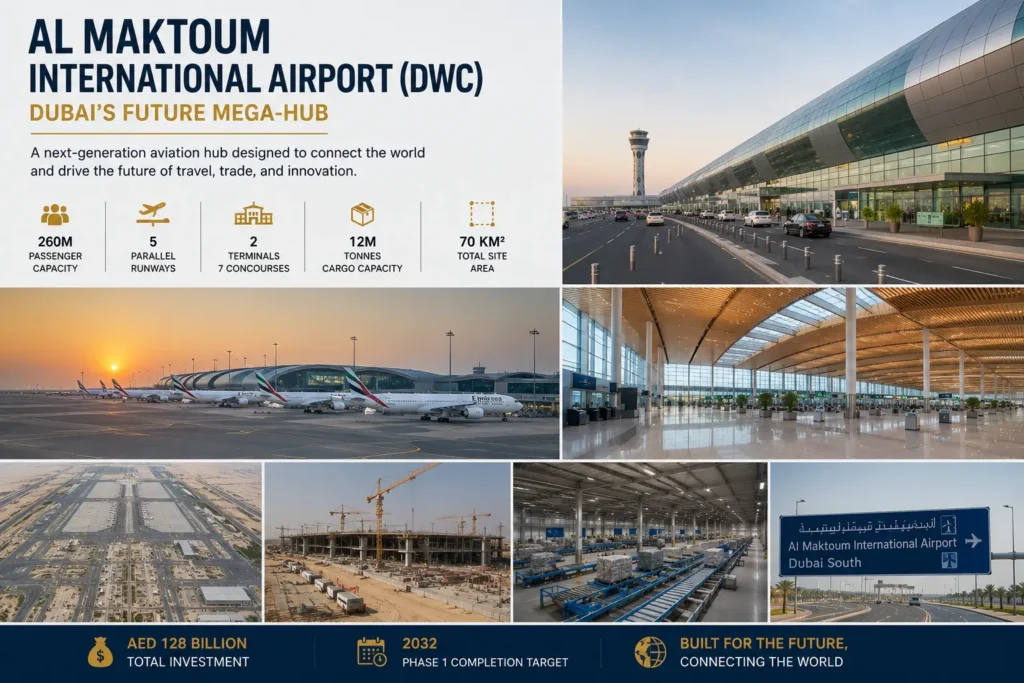
Al Maktoum International Airport (DWC) is not just another airport project. It is a $35 billion bet that Dubai will remain the world’s aviation capital for the next century. When completed, DWC will be the largest airport ever built by human hands: five parallel runways, 430 aircraft gates, two passenger terminals, seven concourses, and capacity for 260 million passengers a year. That is nearly three times what Dubai International Airport (DXB) handled at its record-breaking peak in 2025.
The scale is difficult to absorb. The airport site covers 70 square kilometers, more than five times the size of DXB. The West Terminal alone, the centerpiece of Phase 1, will process 45 million passengers annually, a figure that rivals the total capacity of many major airports worldwide. Underground automated people mover systems will shuttle passengers between terminals and concourses across a facility so large that conventional walking distances would be impractical.
DWC is not a future fantasy. As of mid-2026, construction is actively underway. More than AED 13 billion ($3.5 billion) in contracts are being executed. Over 10 million work hours have been completed in the preceding 15 months. The second runway is finished. Over 17,000 concrete piles have been driven, and more than 45 million cubic meters of earth have been excavated. An additional AED 55 billion ($15 billion) in strategic contracts is expected to be awarded before the end of 2026.
| Detail | Data |
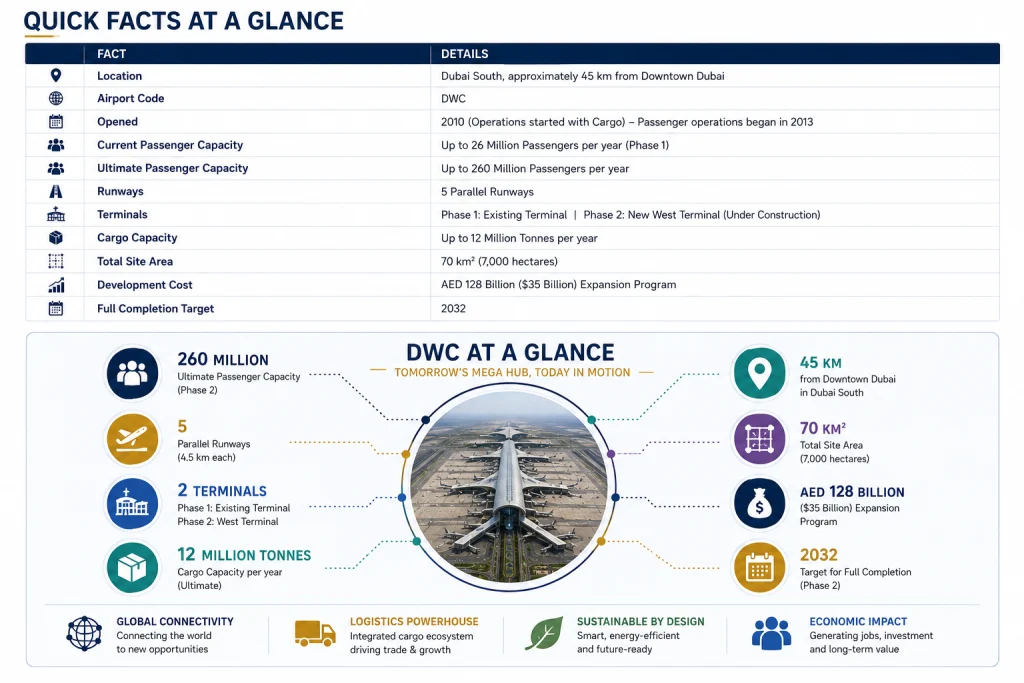
| Official Name | Al Maktoum International Airport |
| Also Known As | Dubai World Central (DWC) |
| IATA Code | DWC |
| ICAO Code | OMDW |
| Location | Dubai South, near Jebel Ali, UAE |
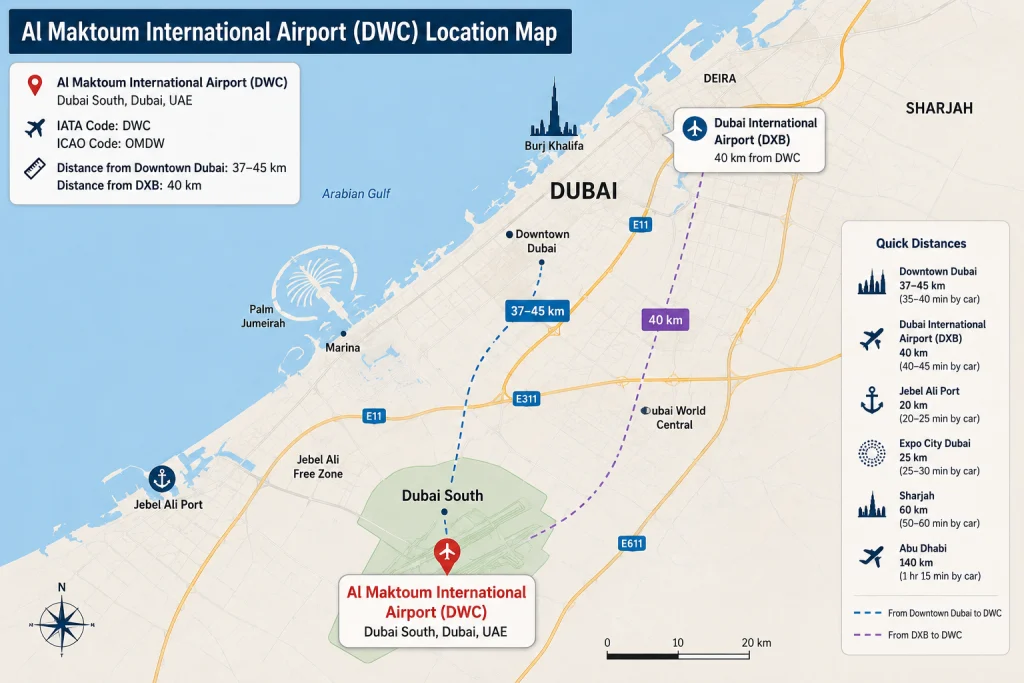
| Distance from Downtown Dubai | 37-45 km (23-28 miles) southwest |
| Distance from DXB | 40 km |
| Site Area | 70 square kilometers (ultimate build-out) |
| Current Passenger Capacity | 26 million passengers/year |
| Phase 1 Capacity (2032) | 150 million passengers/year |
| Ultimate Capacity | 260 million passengers/year |
| Cargo Capacity (Ultimate) | 12 million tonnes/year |
| Runways | 5 parallel (4.5 km each, Code F) |
| Terminals | 2 passenger terminals |
| Concourses | 7 |
| Aircraft Gates | 430+ |
| Expansion Cost | AED 128 billion ($34.8 billion) |
| Phase 1 Opening | 2032 (officially confirmed) |
| Operator | Dubai Airports |
| Official Website | dubaiairports.ae |
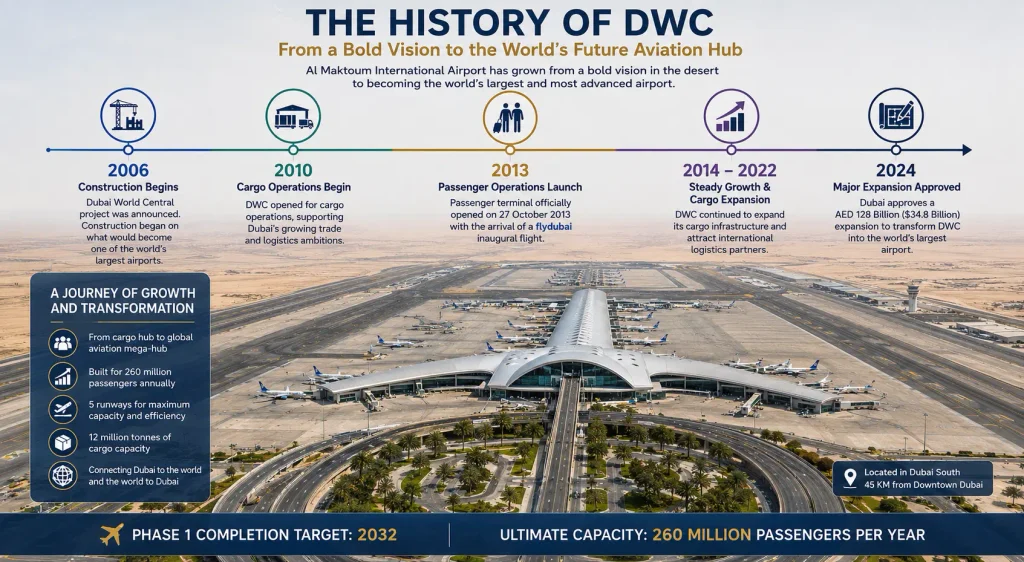
The story of DWC begins with Dubai’s long-term strategic vision. By the early 2000s, it was already clear that Dubai International Airport, despite its rapid expansion, would eventually hit physical limits. The airport sits in Al Garhoud, a dense urban district with no room to add runways or build new terminals without demolishing surrounding neighborhoods.
In 2006, construction began on a new airport in the desert south of Dubai, near Jebel Ali and the planned Dubai South development. The site was chosen for its vast open space, proximity to Jebel Ali Port (one of the world’s busiest container ports), and access to major highways including Sheikh Zayed Road (E11), Sheikh Mohammed Bin Zayed Road (E311), and Emirates Road (E611).
On June 27, 2010, cargo operations commenced at DWC, making it the first operational phase of the airport. The first cargo terminal was completed, and the airport began handling freight for major logistics operators. Emirates SkyCargo became one of the earliest and largest tenants.
On October 27, 2013, the passenger terminal officially opened for commercial passenger operations. The initial terminal was designed to handle approximately 5 million passengers annually, with the capacity to expand to 7 million. The airport served a mix of low-cost carriers, seasonal charter flights, and regional services.
In 2018, the passenger terminal was expanded and upgraded, increasing annual capacity to 26 million passengers. This upgrade included additional check-in counters, expanded security screening areas, new retail and dining outlets, and improved baggage handling systems.
All pure cargo operators were moved from DXB to DWC by May 2014, establishing DWC as Dubai’s primary cargo hub. During the COVID-19 pandemic in 2020, some cargo operations temporarily returned to DXB, but by March 2022, the full cargo operation had been restored at DWC.
The pivotal moment came on April 28, 2024, when Sheikh Mohammed bin Rashid Al Maktoum, Vice President and Prime Minister of the UAE and Ruler of Dubai, approved a AED 128 billion ($34.8 billion) expansion of DWC. This decision transformed DWC from a secondary airport into the centerpiece of Dubai’s long-term aviation strategy
| Year | Milestone |
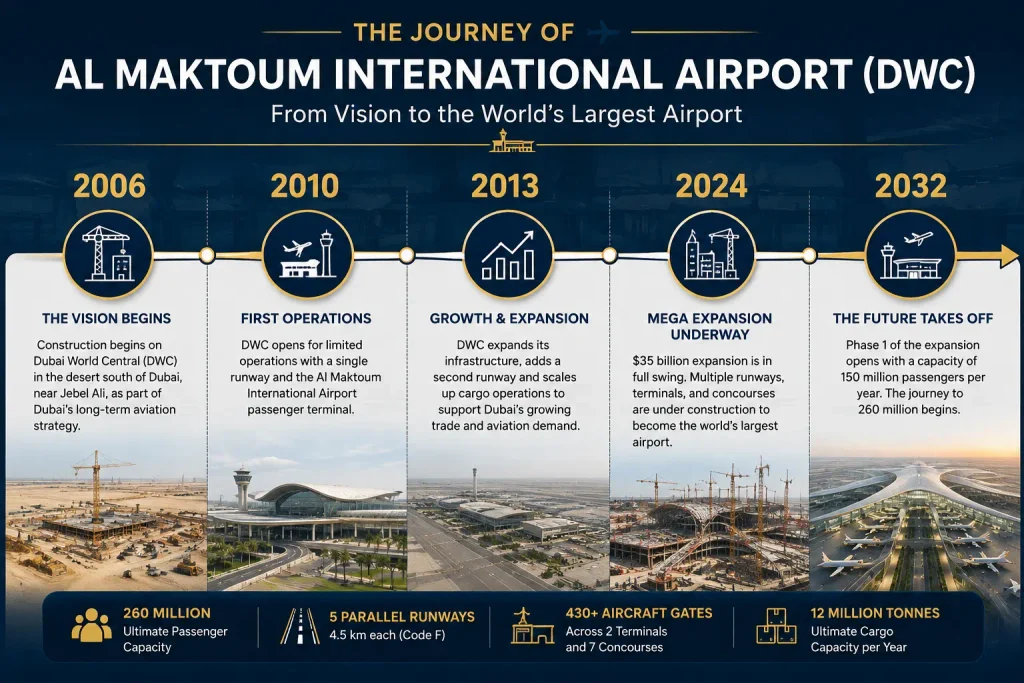
| 2006 | Construction begins on the first runway and control tower |
| 2010 | Cargo operations commence (June 27) |
| 2013 | Passenger terminal opens (October 27) |
| 2014 | All cargo operators moved from DXB to DWC |
| 2018 | Passenger terminal expanded to 26 million annual capacity |
| 2020 | COVID-19: some cargo operations temporarily return to DXB |
| 2022 | Full cargo operations restored at DWC (March) |
| 2024 | AED 128 billion expansion approved by Sheikh Mohammed (April 28) |
| 2026 | Second runway completed; AED 13 billion in contracts executed |
| 2032 | Phase 1 of expansion scheduled to open |
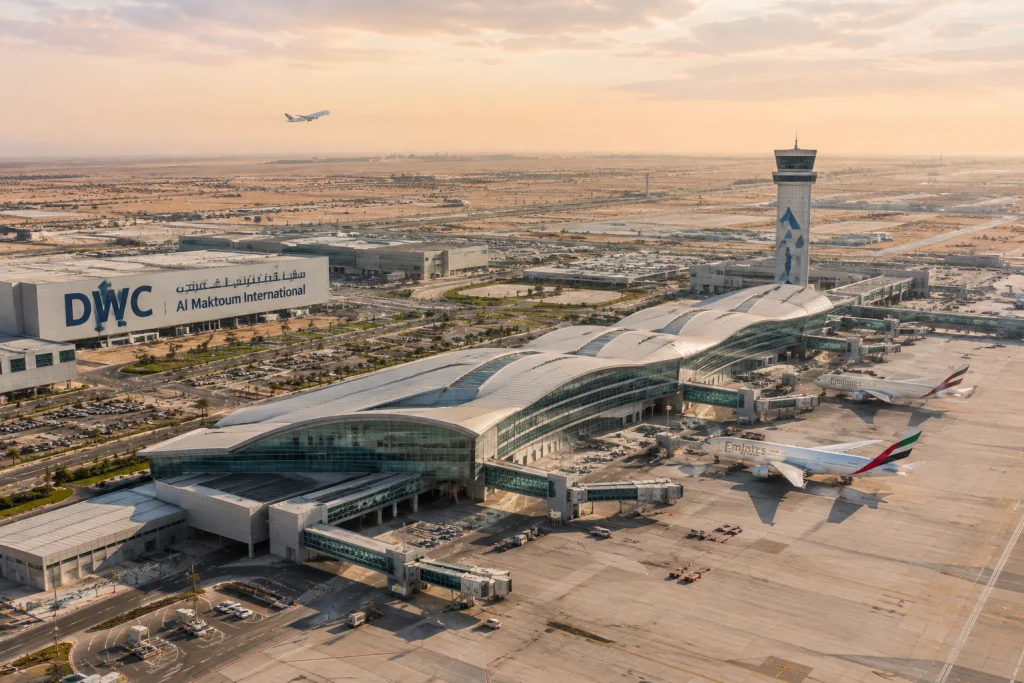
In its current form, DWC operates as Dubai’s secondary airport, handling a mix of low-cost carriers, seasonal charter flights, regional services, and cargo operations. The airport is significantly quieter and less crowded than DXB, which some travelers prefer for its faster processing times and shorter queues.
The current passenger terminal has a capacity of 26 million passengers annually and features three levels:
Terminal facilities include duty-free shopping, restaurants and cafés, free Wi-Fi, currency exchange, information desks, and VIP lounges.
DWC’s cargo facilities are among the most advanced in the world. The cargo terminal has a built-up area of 41,129 square meters and handles both perishable and non-perishable goods. The facility includes cold storage, specialized handling areas, customs clearance services, animal cargo facilities, dangerous goods storage, and valuable cargo areas.
Major cargo operators at DWC include Emirates SkyCargo, DHL, FedEx, UPS, Cargolux, and Qatar Airways Cargo. The airport currently serves approximately 45 destinations through 20+ cargo carriers.
The following airlines currently operate from DWC:
| Category | Airlines |
| Low-Cost Carriers | Wizz Air Abu Dhabi, Jazeera Airways, Air Arabia |
| Regional Carriers | Kuwait Airways, flydubai (select routes) |
| European Charter | SmartWings, Eurowings, Transavia, Luxair, Enter Air |
| CIS/Russian Carriers | Ural Airlines, Utair, Rossiya Airlines, Aeroflot |
| Cargo Operators | Emirates SkyCargo, DHL, FedEx, UPS, Cargolux, Turkish Cargo |
DWC handled approximately 2.1 million passengers in 2024, a 24% increase year-over-year as operations continue to expand. Aircraft movements totaled 30,737 in 2024, up 10.7% from 27,758 in 2023. While these numbers are modest compared to DXB, they reflect DWC’s role as a complementary facility that will scale dramatically once the expansion is complete.
The expansion of DWC is the largest single aviation infrastructure investment in global history. Approved in April 2024, the project carries a total cost of AED 128 billion ($34.8 billion) and will transform DWC from a 26-million-passenger airport into a 260-million-passenger mega-hub.
Phase 1 is the most critical milestone. It is officially scheduled to open in 2032 and will deliver:
The West Terminal alone is comparable in scale to many major hub airports worldwide. Its seven-level design optimizes passenger flow, with separate levels for arrivals, check-in, departures, and premium services.
Phase 2 will complete the airport’s ultimate configuration:
No definitive date has been announced for the completion of Phase 2. Dubai officials have described it as a long-term master plan that will be built in stages as demand grows.
As of June 2026, Dubai officials confirmed the project remains on schedule. Key milestones include:
| Metric | Status |
| Contracts Under Execution | AED 13 billion ($3.5 billion) |
| Additional Contracts Expected | AED 55 billion ($15 billion) by end of 2026 |
| Work Hours Completed | 10 million+ in preceding 15 months |
| Concrete Piles Completed | 17,000+ |
| Excavation Completed | 45 million+ cubic meters |
| Second Runway | Completed |
| Terminal Structural Work | Underway |
| Workforce (Current) | ~9,000 workers |
| Workforce (Projected Peak) | 120,000 laborers |
Emirates has committed $10-12 billion to the project, signaling that the airline is preparing for its eventual relocation from DXB to DWC.
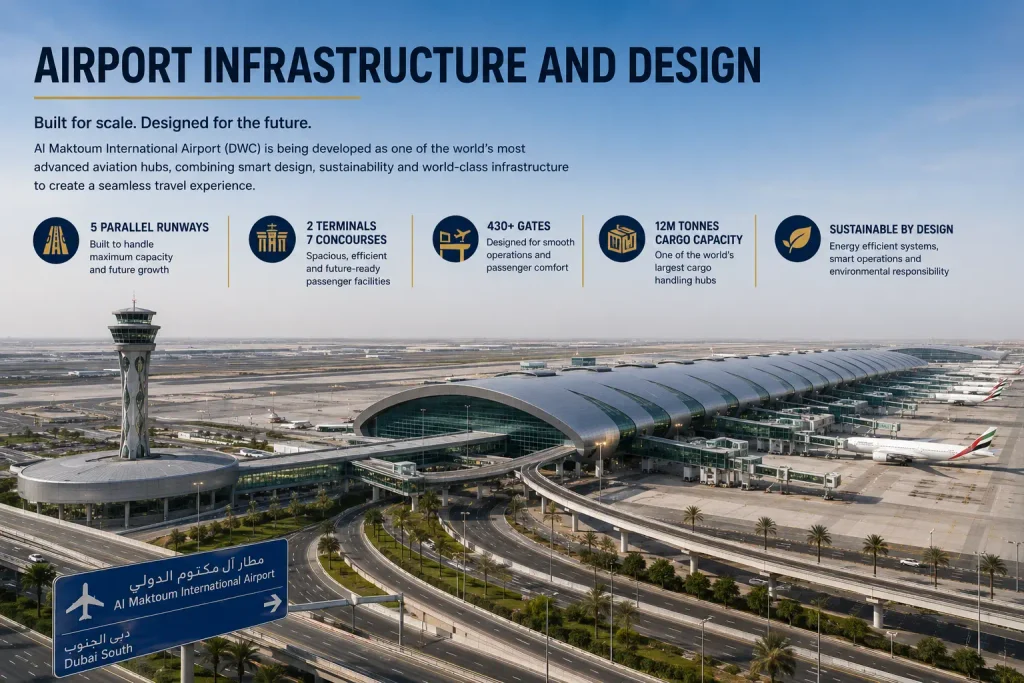
DWC will feature five parallel Code F runways, each 4.5 kilometers long. Code F runways are designed to accommodate the largest commercial aircraft in service, including the Airbus A380 and Boeing 747-8. The runways are separated by a minimum distance of 800 meters, allowing multiple simultaneous approaches and reducing arrival and departure bottlenecks.
The first runway was completed in 2006 and set an aviation record for the fastest A380-enabled 4.5 km CAT II runway construction. The second runway was completed in 2026. The remaining three runways will be built as part of Phase 2.
DWC will have two passenger terminals when fully built:
Both terminals will be connected by an underground Automated People Mover (APM) system with 14 stations, designed to move passengers efficiently across the vast airport campus.
The airport will have seven concourses in total, connected to more than 430 aircraft contact stands. The concourses are designed to minimize walking distances through the APM system and to provide flexible gate assignments for airlines of different sizes.
DWC’s cargo infrastructure is designed to handle 12 million tonnes annually, making it one of the largest cargo hubs in the world. The cargo terminal features:
The expansion is designed with sustainability as a core principle:
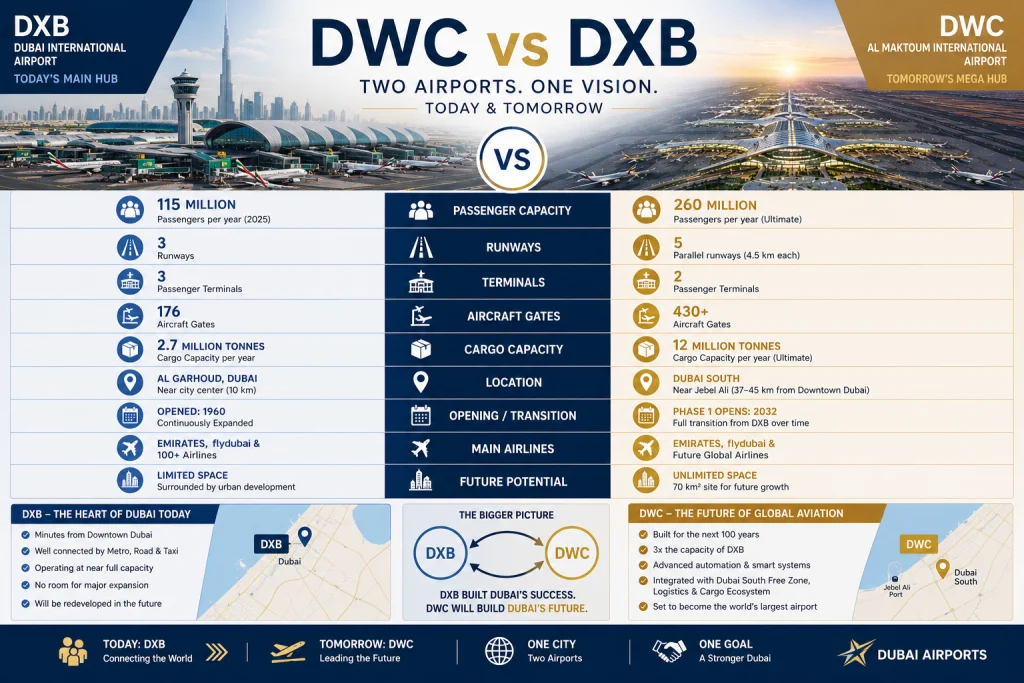
Dubai currently operates two airports, and understanding the differences between them is essential for travelers.
| Feature | DXB (Dubai International) | DWC (Al Maktoum International) |
| Location | Al Garhoud, 4.6 km from city center | Dubai South, 37-45 km from city center |
| IATA/ICAO | DXB/OMDB | DWC/OMDW |
| Annual Capacity | 115 million passengers | 26 million (current) / 260 million (ultimate) |
| Runways | 2 parallel (4 km each) | 1 active (4.5 km) / 5 planned |
| Terminals | 3 (T1, T2, T3) | 1 (expanding to 2) |
| Concourses | 4 (A, B, C, D) | 1 (expanding to 7) |
| Primary Airlines | Emirates, flydubai | Wizz Air, charter carriers, cargo |
| Passenger Traffic (2024) | 92.3 million | 2.1 million |
| Cargo | 2.20 million tonnes | Growing cargo hub |
| Metro Access | Yes (Red Line, T1 and T3) | Planned (Route 2020 extension) |
| Future | Will eventually close | Will become Dubai’s primary hub |
The key takeaway: DXB is Dubai’s current primary airport and will continue to operate for years. DWC is the future, but the transition will be gradual, with Phase 1 opening in 2032 and the full migration taking place over the following decade.
DWC is located approximately 37-45 kilometers southwest of Downtown Dubai, near Jebel Ali and the Dubai South development. The airport is accessible via multiple transport modes, though connectivity is less extensive than DXB until the planned metro extension is completed.
DWC is accessible from three major highways:
Official Dubai taxis and rideshare services (Uber, Careem) operate from DWC. The ride to Downtown Dubai takes approximately 35-45 minutes depending on traffic, with fares starting at around AED 120.
RTA bus services connect DWC to Dubai Metro stations and key locations in Dubai. The bus journey takes approximately 60 minutes and costs around AED 25.
The RTA has begun design work on a Route 2020 metro extension that will run approximately 3 kilometers from Expo 2020 station to the Al Maktoum West Terminal, adding two new stations. This extension will provide a direct rail link between DWC and Dubai’s metro network.
Additionally, tender documents reported in 2026 describe an Airport Express Line linking DXB in Garhoud to Al Maktoum, running through corridors including Al Jaddaf, Al Khail Road, and Jumeirah Village Circle. Etihad Rail has also confirmed that its first passenger stations in Abu Dhabi, Dubai, Sharjah, and Fujairah will integrate with metro and bus networks.
All major car rental companies are available at DWC. The airport offers multiple parking options for short-term and long-term stays, with rates starting at AED 10 per hour.
| Mode | Cost to Downtown | Travel Time | Availability |
| Taxi/Uber/Careem | AED 120+ | 35-45 minutes | 24/7 |
| Bus | AED 25 | ~60 minutes | Regular service |
| Car Rental | Varies | 35-45 minutes | 24/7 |
| Metro (Planned) | TBD | TBD | Not yet operational |
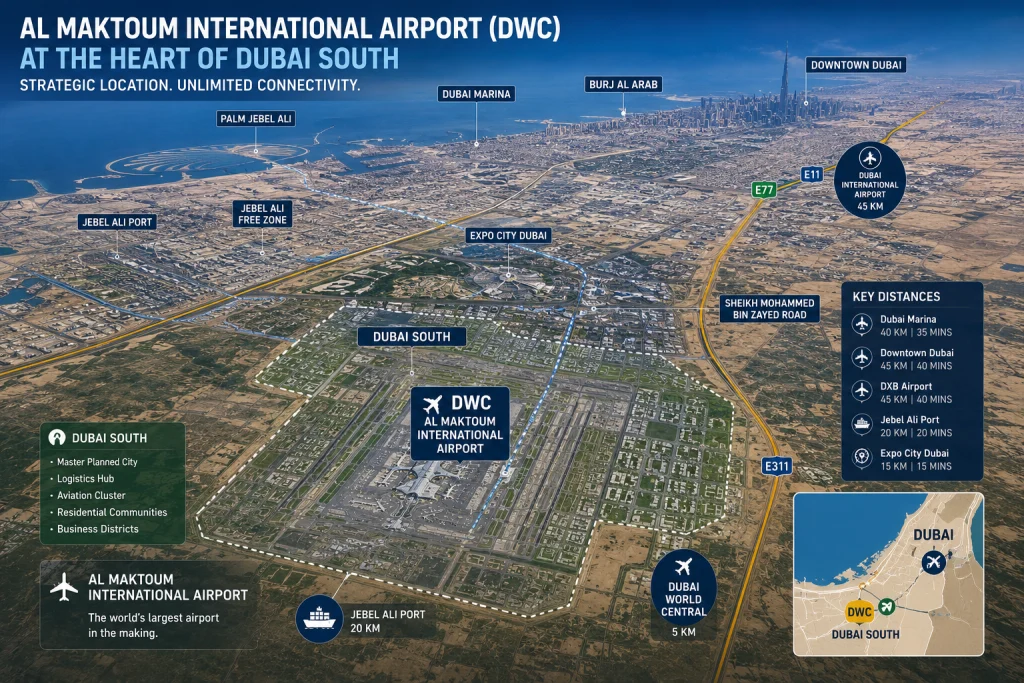
DWC is not just an airport project. It is the anchor of Dubai South, a 140-square-kilometer master-planned development that Dubai envisions as a city for one million residents. The development includes residential areas, commercial zones, logistics districts, and the Dubai South free zone.
The airport’s expansion is expected to drive significant economic activity in the surrounding area. Property transactions in Dubai South already exceeded prior full-year totals before the airport even opens. Dubai South property deals topped AED 15 billion in just the first five months of 2025, surpassing nearly the entire AED 16.1 billion recorded for all of 2024. Rents in the surrounding area jumped 20% over the past 12 months.
The proximity to Jebel Ali Port, one of the world’s busiest container ports, creates a powerful logistics ecosystem. Cargo arriving by air at DWC can be transferred to sea transport at Jebel Ali within minutes, and vice versa. This sea-air connectivity is a major competitive advantage for DWC as a global cargo hub.
When DWC’s Phase 1 opens in 2032, Emirates and flydubai will begin the gradual migration from DXB to DWC. The transition will not be a single overnight closure. It will unfold over years, with airlines shifting operations progressively as DWC’s facilities come online.
Once aviation activity leaves DXB, the Al Garhoud site will become one of Dubai’s largest urban regeneration opportunities. Dubai Airports CEO Paul Griffiths has spoken about the strategic value of the land and the scale of redevelopment potential. The 2,900-hectare site, located just 4.6 kilometers from the city center, represents an enormous canvas for residential, commercial, and mixed-use development.
No formal redevelopment plan for the DXB site has been published yet. Griffiths has indicated that the details will be revealed closer to the time of the transition.
The DWC expansion is one of the largest infrastructure investments in the Middle East and will create significant economic activity:
DWC’s capacity targets place it above most global airport expansion projects:
| Airport | Phase 1 Capacity | Ultimate Capacity | Runways | Cost |
| Al Maktoum (DWC) | 150 million | 260 million | 5 | $34.8 billion |
| King Salman Intl (Riyadh) | 120 million | 185 million | 6 | $147 billion |
| Istanbul Airport | 90 million | 200 million | 6 | $12 billion |
| Hong Kong (3-runway) | 120 million | 120 million | 3 | $18 billion |
| DXB (current) | 115 million | 115 million | 2 | N/A |
DWC’s 260 million passenger target sits above all of these benchmarks, positioning it as the largest airport capacity target in the world.
Check your airline first. DWC serves a different mix of airlines than DXB. Wizz Air Abu Dhabi, Jazeera Airways, and many charter carriers operate from DWC. If you are flying Emirates or flydubai, you are likely departing from DXB, not DWC.
Allow extra travel time. DWC is 37-45 km from Downtown Dubai, compared to DXB’s 4.6 km. Plan for a 35-45 minute drive by taxi or rideshare.
Use the bus if budget matters. RTA bus services connect DWC to metro stations for around AED 25. The journey takes about 60 minutes.
Expect shorter queues. DWC handles a fraction of DXB’s traffic. Check-in, security, and immigration processing are generally faster.
Cargo-focused amenities. DWC’s current terminal is functional but not as extensive as DXB’s in terms of retail and dining. Plan accordingly for long layovers.
Track expansion progress. The airport is actively expanding. Check Dubai Airports’ official channels for updates on new routes and facilities.
DWC faces several constraints in its current form. The airport is far from Dubai’s city center, with no direct metro connection yet. This limits its attractiveness for passengers who value convenience and proximity.
The current terminal, while functional, is not at the scale or quality level of DXB’s facilities. Retail and dining options are more limited, and the overall passenger experience is geared toward efficiency rather than luxury.
The construction timeline carries inherent risk. Large-scale infrastructure projects of this magnitude frequently experience delays and cost overruns. While Dubai has a strong track record of delivering major projects, the 2032 target for Phase 1 will require sustained execution over the next six years.
The transition from DXB to DWC also creates uncertainty for airlines and passengers. Emirates has committed to the move, but the gradual nature of the transition means that Dubai will operate two airports simultaneously for an extended period, adding complexity to operations and ground transport planning.
Al Maktoum International Airport represents the most ambitious airport project in aviation history. The numbers are staggering: $35 billion in investment, 260 million passengers at full capacity, five parallel runways, 430 gates, and a site larger than some cities.
The project is not a concept or a rendering. Construction is actively underway, with AED 13 billion in contracts being executed and the second runway already completed. Phase 1 is officially scheduled to open in 2032, when Dubai will begin the historic transition from DXB to its new mega-hub.
For travelers in the near term, DWC serves as a quieter, more efficient alternative to DXB for airlines like Wizz Air and charter carriers. For the aviation industry and investors, DWC represents the future of global air connectivity, positioned at the crossroads of Europe, Asia, and Africa with the capacity to handle a quarter of a billion passengers annually.
The question is not whether DWC will open. It is already being built. The question is how quickly Dubai can deliver on a vision so vast that it redefines what an airport can be.
Al Maktoum International Airport (DWC) is Dubai’s second airport, located in Dubai South near Jebel Ali. Also known as Dubai World Central, it currently serves low-cost carriers, charter flights, and cargo operations while undergoing a $35 billion expansion to become the world’s largest airport by 2032.
The expansion approved in April 2024 carries a total cost of AED 128 billion ($34.8 billion). As of mid-2026, more than AED 13 billion in contracts are being executed, with an additional AED 55 billion expected to be awarded by end of 2026.
Phase 1 of the expanded airport is officially scheduled to begin operations in 2032, with capacity for 150 million passengers annually. Full build-out to five runways and 260 million passengers does not yet have a confirmed completion date.
Yes. Dubai’s leadership has confirmed that Emirates and flydubai operations will eventually transfer to DWC once its new facilities are complete. Emirates has committed $10-12 billion to the project.
DWC is approximately 37-45 kilometers southwest of Downtown Dubai, roughly a 35-45 minute drive by taxi or rideshare depending on traffic.
Current operators include Wizz Air Abu Dhabi, Jazeera Airways, Kuwait Airways, Air Arabia, SmartWings, Eurowings, Ural Airlines, and Emirates SkyCargo for cargo operations.
No. DXB (Dubai International Airport) is Dubai’s current primary hub near the city center. DWC (Al Maktoum International) is the secondary airport in Dubai South that will eventually replace DXB as Dubai’s main aviation gateway.
The airport site covers 70 square kilometers at full build-out, which is more than five times the size of DXB. It is part of the larger 140-square-kilometer Dubai South development.