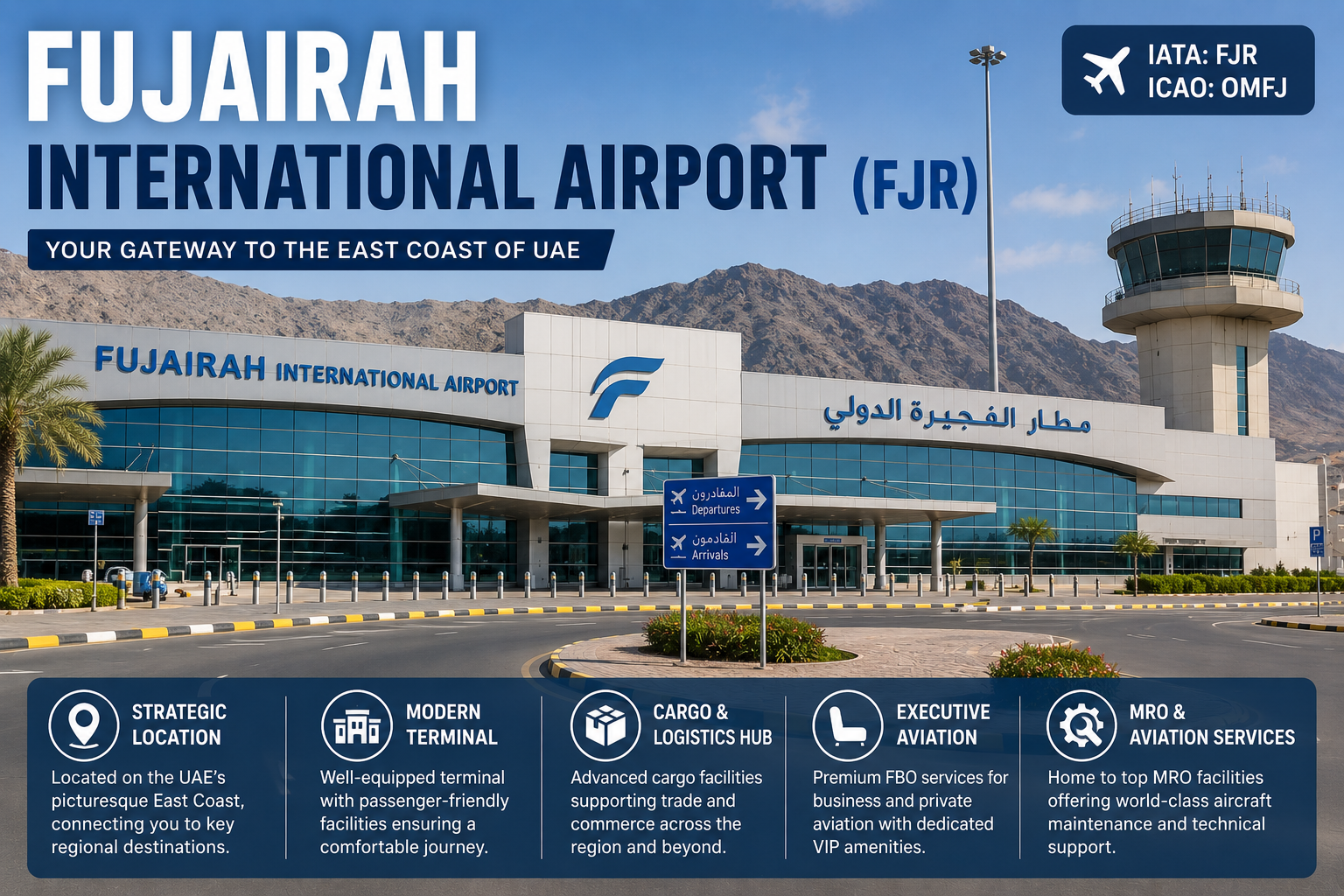
Fujairah International Airport (FJR) recorded the strongest percentage growth among UAE airports in 2025, with passenger numbers climbing 170% to 164,600 from 61,100 in 2024. Located on the eastern coast of the UAE, just 1.9 kilometers south of Fujairah City, the airport has undergone a remarkable transformation from a primarily cargo-focused facility into a growing passenger gateway with ambitions to become a major regional aviation hub.
Opened in October 1987, FJR has evolved through a $445 million expansion programme completed in 2022, which delivered a new 3,050-meter parallel runway capable of handling wide-body aircraft including the Airbus A380. The airport now serves 10 destinations across four countries, with airlines including IndiGo, SpiceJet, Pakistan International Airlines, and SalamAir connecting Fujairah to India, Pakistan, Oman, and Germany.
This guide covers everything about Fujairah International Airport: its history, the $445 million expansion, current operations, airlines and destinations, cargo hub, aircraft recycling, the Fujairah Aviation Academy, and practical travel tips for visitors to the UAE’s eastern coast.
Quick Facts at a Glance
| Detail | Data |
| Official Name | Fujairah International Airport |
| IATA Code | FJR |
| ICAO Code | OMFJ |
| Arabic Name | مطار الفجيرة الدولي |
| Location | 1.9 km south of Fujairah City, eastern coast of UAE |
| Opened | October 1987 |
| Operator | Department of Civil Aviation, Fujairah |
| Elevation | 47 meters (153 feet) above sea level |
| Runway 1 | 11/29 — 3,749 m (asphalt) |
| Runway 2 (New) | 12/30 — 3,050 m x 45 m (opened December 2022) |
| Terminal | 1 terminal — 3 gates, 12 check-in counters |
| Annual Capacity | 2 million passengers |
| Passengers (2025) | 164,600 (+170% year-on-year) |
| Passengers (2024) | 61,100 |
| Cargo Terminal | 9,000 sqm warehouse with cold storage & livestock facilities |
| Destinations | 10 international |
| Airlines | 5+ scheduled carriers |
| Expansion Cost | $445 million |
| Phone | +971 9 222 2244 |
| Official Website | www.fujairah-airport.ae |
History of Fujairah International Airport
Inauguration and Early Operations (1987-2013)
Fujairah International Airport was inaugurated in October 1987 under the leadership of His Highness Sheikh Hamad bin Mohammed Al Sharqi, Ruler of Fujairah. The airport was established to enhance regional connectivity and support the economic diversification of the emirate, which is the only UAE emirate with coastline on both the Gulf of Oman and the Arabian Gulf.
In its early years, the airport concentrated on cargo operations, serving as a logistics gateway for Fujairah’s resource-based economy. Passenger traffic remained modest, with annual figures averaging under 100,000. By 2016, the airport handled just 33,682 passengers and 9,692 aircraft movements, reflecting its role as a regional facility with limited international connectivity.
Despite the low passenger volumes, the airport developed a reputation for specialized services including aircraft dismantling and maintenance, cargo handling with cold storage and livestock facilities, and pilot training through the Fujairah Aviation Academy. These diversified revenue streams helped sustain operations during periods of limited passenger growth.
The $445 Million Expansion (2014-2022)
A pivotal moment came in May 2014, when the Department of Civil Aviation of the Emirate of Fujairah signed a Memorandum of Cooperation (MoC) with Abu Dhabi Airports to develop a comprehensive master plan for the airport’s expansion. The agreement facilitated technical advisory support for expansion initiatives aimed at handling larger aircraft, including the Airbus A380.
In March 2018, a $445 million contract was awarded to a joint venture between Egyptian firm Orascom Construction and UAE-based Al Sahraa Group for the airport’s major expansion project. The total cost of the expansion was financed by the Federal Government of the UAE in collaboration with Abu Dhabi Airports.
The expansion programme included:
- Construction of a new 3,050-meter parallel runway (opened December 2022)
- Widening of the existing runway from 45m to 60m
- Construction of new parallel taxiways and rapid-exit taxiways
- Building a new 51-meter-high falcon-style air traffic control tower
- Installation of advanced air traffic management systems and navigational aids
- Development of a 33kV power plant with 40MVA capacity
- Electrical substation and distribution network
- Upgraded airfield ground and approach lighting systems
- Terminal upgrades to handle 2 million passengers annually
The project was completed by 2022, with the new parallel runway inaugurated on December 3, 2022, by Sheikh Hamad bin Saleh Al Sharqi, who became the first pilot to use it. The upgraded infrastructure enabled the airport to handle wide-body aircraft and positioned it for significant passenger growth.
Passenger Growth Era (2021-Present)
The first major passenger airline to operate from FJR was Pakistan International Airlines, which began flights from Peshawar and Islamabad on November 25, 2021, becoming the first international airline to fly directly to Fujairah. This marked the beginning of the airport’s transition from a primarily cargo facility to a mixed passenger-cargo hub.
In 2023, SalamAir added Fujairah to its expanding list of GCC destinations, offering regular flights to Muscat and seasonal services to Salalah. EgyptAir also launched flights to Cairo, further expanding the airport’s international connectivity.
The most significant growth driver came in May 2025, when IndiGo launched daily direct flights to Mumbai and Kannur using Airbus A320neo aircraft. These year-round services transformed FJR’s passenger profile, connecting Fujairah to major Indian cities and supporting the emirate’s large South Asian expatriate community. SpiceJet also operated seasonal services to Kochi, Kozhikode, and Mumbai during peak travel periods.
Key Milestones
| Year | Milestone |
| 1987 | Airport inaugurated by Sheikh Hamad bin Mohammed Al Sharqi |
| 2014 | Memorandum of Cooperation signed with Abu Dhabi Airports |
| 2016 | 33,682 passengers; 9,692 aircraft movements |
| 2018 | $445 million expansion contract awarded to Orascom-Al Sahraa JV |
| 2021 | Pakistan International Airlines becomes first international passenger carrier |
| 2022 (Dec) | New 3,050m parallel runway inaugurated |
| 2023 | SalamAir and EgyptAir launch services |
| 2024 | 61,100 passengers |
| 2025 (May) | IndiGo launches daily flights to Mumbai and Kannur |
| 2025 (Jun) | Record passenger surge during Eid Al-Adha |
| 2025 (Sep) | First drone cargo delivery to offshore platform tested |
| 2025 | 164,600 passengers — 170% year-on-year growth |
Current Operations at FJR
Terminal Facilities
FJR has a single passenger terminal with three gates and 12 check-in counters on the ground floor. The terminal is designed for efficient processing of regional flights, with dedicated areas for immigration and customs processing. Facilities include duty-free shopping, lounges, dining options, free Wi-Fi, and comfortable seating areas.
Following the expansion programme, the terminal has an annual capacity of up to 2 million passengers, far exceeding current volumes and providing significant room for growth as new airlines and routes are added.
Runways and Airside
FJR now has two runways:
- Runway 11/29: 3,749 meters (12,300 feet) — the original runway
- Runway 12/30: 3,050 meters x 45 meters — new parallel runway opened December 2022
The upgraded airfield includes 60-meter-wide taxiways, rapid-exit taxiways for efficient operations, and advanced airfield lighting systems. The infrastructure is capable of accommodating wide-body aircraft including the Boeing 777, Airbus A330, and even the Airbus A380.
Airlines and Destinations
FJR is served by five airlines connecting to 10 destinations across four countries. The route network focuses on the Indian subcontinent, Middle East, and Europe.
| Airline | Destinations | Frequency | Aircraft |
| IndiGo | Mumbai (BOM) | Daily | Airbus A320neo |
| IndiGo | Kannur (CNN) | Daily | Airbus A320neo |
| SpiceJet | Kochi (COK) | Daily (seasonal) | Boeing 737-800 |
| SpiceJet | Kozhikode (CCJ) | Daily (seasonal) | Boeing 737-800 |
| SpiceJet | Mumbai (BOM) | 6x weekly | Boeing 737 |
| Pakistan International Airlines | Islamabad (ISB) | Weekly | Various |
| Pakistan International Airlines | Peshawar (PEW) | Weekly | Various |
| Pakistan International Airlines | Lahore (LHE) | Weekly | Various |
| SalamAir | Muscat (MCT) | Regular | Various |
| Maximus Air | Hahn (HHN), Germany | Cargo | Various |
Passenger Traffic
| Year | Passengers | Growth |
| 2016 | 33,682 | — |
| 2019 | ~50,000 | — |
| 2022 | ~60,000 | — |
| 2024 | 61,100 | — |
| 2025 | 164,600 | +170% |
The 170% passenger growth in 2025 represents the strongest percentage increase among all UAE airports, driven primarily by IndiGo’s new daily services to Mumbai and Kannur, seasonal SpiceJet operations, and a significant surge during Eid Al-Adha. FJR’s passenger traffic more than doubled in a single year, signalling the airport’s emergence as a serious player in UAE aviation.
Cargo Hub and Logistics
Fujairah International Airport has historically been primarily a cargo facility, and freight operations remain a core part of its business model. The airport’s cargo terminal spans 9,000 square meters and is equipped to handle diverse types of freight.
Cargo Facilities
- 9,000 sqm cargo warehouse
- Cold storage facilities for temperature-sensitive shipments
- Livestock holding areas with capacity for up to 2,500 heads
- Dangerous goods handling capabilities
- Direct access to aircraft for efficient turnaround
- Customs clearance services
- Integration with Port of Fujairah for multimodal transport
Strategic Location
FJR’s proximity to the Port of Fujairah — one of the world’s largest oil bunkering hubs and a major container port — creates unique opportunities for integrated air-sea logistics. Cargo arriving by air can be quickly transferred to the port for onward shipment, and vice versa, enabling seamless multimodal transport for businesses in the region.
The airport handles general cargo, perishables, dangerous goods, livestock, and oil-related products. Russian carriers such as Abakan Air operate Ilyushin Il-76 TD cargo charters from the airport, supporting ad-hoc freight movements based on demand.
Drone Cargo Innovation
In September 2025, FJR tested inaugural drone cargo deliveries to offshore platforms, advancing sustainable and efficient logistics in the region. This innovative trial positioned the airport as a pioneer in drone-based cargo operations in the UAE, with potential applications for offshore oil and gas operations in the Gulf of Oman.
Aircraft Dismantling and Recycling
FJR is home to a unique aviation service: aircraft dismantling and recycling. Falcon Aircraft Recycling, established in Fujairah, manages the process of dismantling end-of-life aircraft and separating waste streams into recoverable materials.
“This business is not about scrapping aircraft,” said Ian French, the chief operations officer at Falcon Aircraft Recycling. “It is about a totally managed process of aircraft dismantling and separation of the waste streams into a range of recoverable materials.”
The facility salvages everything from seat-belt buckles to engine parts, as well as precious metals including gold and palladium. The hangar at FJR can accommodate wide-body aircraft for dismantling, making it one of the few facilities in the region capable of handling large commercial jets.
This specialized service generates revenue streams for the airport beyond traditional passenger and cargo operations, contributing to the emirate’s economic diversification goals.
Fujairah Aviation Academy
FJR is home to the Fujairah Aviation Academy (FAA), a GCAA-approved training institution delivering pilot licensing, aircraft maintenance engineering, and related aviation disciplines. The academy contributes to the airport’s operational ecosystem by developing skilled aviation professionals for the UAE and the wider region.
The academy’s presence at FJR creates synergies with the airport’s operations, providing training opportunities for pilots, engineers, and other aviation professionals. Students benefit from access to the airport’s operational environment, including its dual-runway configuration and diverse airline operations.
FJR vs RKT vs SHJ: How Fujairah Compares
| Feature | FJR (Fujairah) | RKT (Ras Al Khaimah) | SHJ (Sharjah) |
| Location | Fujairah, 1.9 km from city | RAK, 18 km from city | Sharjah, 13 km from city |
| Passengers (2025) | 164,600 | 1,000,303 | 19.48 million |
| Growth (2025) | +170% | +51% | +13.9% |
| Hub Airline | None (IndiGo focus) | Air Arabia | Air Arabia |
| Runways | 2 | 1 | 1 |
| Runway Length | 3,749 m + 3,050 m | 3,760 m | 4,060 m |
| Terminal Capacity | 2 million | 1.2 million | 20 million |
| Destinations | 10 | 16 | 80+ |
| Airlines | 5+ | 5+ | 20+ |
| Unique Feature | Aircraft recycling + Academy | Wynn casino resort | Budget hub |
| Cargo Focus | High (port integration) | Moderate | High |
Getting to and from FJR
FJR is located just 1.9 kilometers (1 nautical mile) south of Fujairah City centre, making it one of the most conveniently located airports in the UAE. The airport is also accessible from other emirates: approximately 130 km from Dubai (1.5 hours), 120 km from Sharjah (1.25 hours), and 160 km from Abu Dhabi (1.75 hours).
Taxi and Rideshare
Taxis and ride-hailing services are available at the airport. The ride to Fujairah city centre takes approximately 5 minutes, making it one of the shortest airport-to-city transfers in the UAE.
Car Rental
Car rental desks are available at the airport. FJR is well connected to the E84 (Fujairah-Kalba) and E87 (Fujairah-Al Ain) highways, providing easy access to other emirates. The drive to Dubai takes approximately 1.5 hours via the E88 or E611.
Public Transport
Public bus services connect FJR to Fujairah city centre and other emirates. The bus is the cheapest option, with fares starting at AED 5-10.
Transport Comparison
| Mode | Cost to Fujairah City | Cost to Dubai | Travel Time |
| Taxi/Uber | AED 10-15 | AED 120-160 | 5 min / 1.5 hrs |
| Bus | AED 5-10 | AED 25-35 | 15-20 min / 1.5-2 hrs |
| Car Rental | Varies | Varies | 5 min / 1.5 hrs |
Facilities and Services
Terminal Amenities
- Duty-free shopping
- Currency exchange and banking services
- Prayer rooms
- Free Wi-Fi throughout the terminal
- Information desks
- ATMs and cash machines
- Car rental desks
- Passenger lounges
Hotels Near FJR
Several hotels are located in Fujairah city:
- DoubleTree by Hilton Fujairah City — 5-star hotel
- Fujairah Rotana Resort & Spa — beachfront resort
- Le Meridien Al Aqah Beach Resort — luxury beach resort
- Fairmont Fujairah Beach Resort — premium resort
- Concorde Hotel Fujairah — mid-range option
- TIME Moonstone Hotel Apartments — budget-friendly
Nearby Attractions
Fujairah offers unique attractions different from the glitz of Dubai:
- Al Bidyah Mosque — the oldest mosque in the UAE (1446 AD)
- Fujairah Fort — a 16th-century fortress and museum
- Snoopy Island — popular snorkeling and diving spot
- Wadi Wurayah — a protected freshwater wadi with waterfalls
- Al Aqah Beach — pristine beach with mountain backdrop
- Fujairah Museum — archaeological exhibits dating to 6th millennium BC
- Dibba Al-Fujairah — gateway to diving in the Gulf of Oman
- Port of Fujairah — one of the world’s largest oil bunkering hubs
Tips for Travelers
Fly FJR for the eastern coast. If you’re visiting Fujairah, Khor Fakkan, Dibba, or the eastern coast, FJR is much closer than Dubai or Sharjah airports. The airport is just 5 minutes from Fujairah city centre.
Use FJR as an alternative to Dubai. FJR is less congested, faster to process, and often cheaper than DXB. If you’re visiting the eastern UAE, flying into FJR saves significant travel time.
Check IndiGo for India flights. IndiGo operates daily flights to Mumbai and Kannur from FJR. These are the most frequent and reliable services from the airport.
Book car rental in advance. Fujairah is a car-dependent emirate with limited public transport. Renting a car is the best way to explore the eastern coast, wadis, and beaches.
Explore beyond the city. Fujairah offers unique experiences: snorkeling at Snoopy Island, hiking in Wadi Wurayah, visiting the 600-year-old Al Bidyah Mosque, and diving in the Gulf of Oman.
Consider cargo operations. FJR is a working cargo airport with aircraft dismantling facilities. You may see unusual aircraft on the tarmac, including planes being recycled.
Check seasonal routes. SpiceJet operates seasonal services (typically June-September). Verify flight availability before booking, especially during off-peak periods.
FAQ
What is Fujairah International Airport?
Fujairah International Airport (FJR) is an international airport located 1.9 km south of Fujairah City on the eastern coast of the UAE. Opened in 1987, it handled 164,600 passengers in 2025, a 170% increase year-on-year.
How many passengers does FJR handle?
FJR handled 164,600 passengers in 2025, up 170% from 61,100 in 2024. The airport has capacity for 2 million passengers annually.
Which airlines fly from FJR?
FJR is served by IndiGo (daily to Mumbai and Kannur), SpiceJet (seasonal to Kochi, Kozhikode, Mumbai), Pakistan International Airlines (Islamabad, Peshawar, Lahore), SalamAir (Muscat), and Maximus Air (cargo to Hahn, Germany).
Does FJR handle cargo?
Yes. FJR has a 9,000 sqm cargo terminal with cold storage and livestock facilities. The airport is integrated with the Port of Fujairah for multimodal logistics.
What is the runway length at FJR?
FJR has two runways: the original 3,749-meter runway and a new 3,050-meter parallel runway opened in December 2022. Both can handle wide-body aircraft.
Is there aircraft recycling at FJR?
Yes. Falcon Aircraft Recycling operates at FJR, dismantling end-of-life aircraft and recovering materials including precious metals. The hangar can accommodate wide-body aircraft.
What is the Fujairah Aviation Academy?
The Fujairah Aviation Academy is a GCAA-approved training institution at FJR, offering pilot licensing, aircraft maintenance engineering, and other aviation training programmes.
How far is FJR from Dubai?
FJR is approximately 130 km from Dubai (1.5 hours drive), 120 km from Sharjah (1.25 hours), and just 1.9 km from Fujairah city centre (5 minutes).
What is the expansion cost at FJR?
The FJR expansion programme cost $445 million, financed by the Federal Government of UAE in collaboration with Abu Dhabi Airports. The project was completed in 2022.