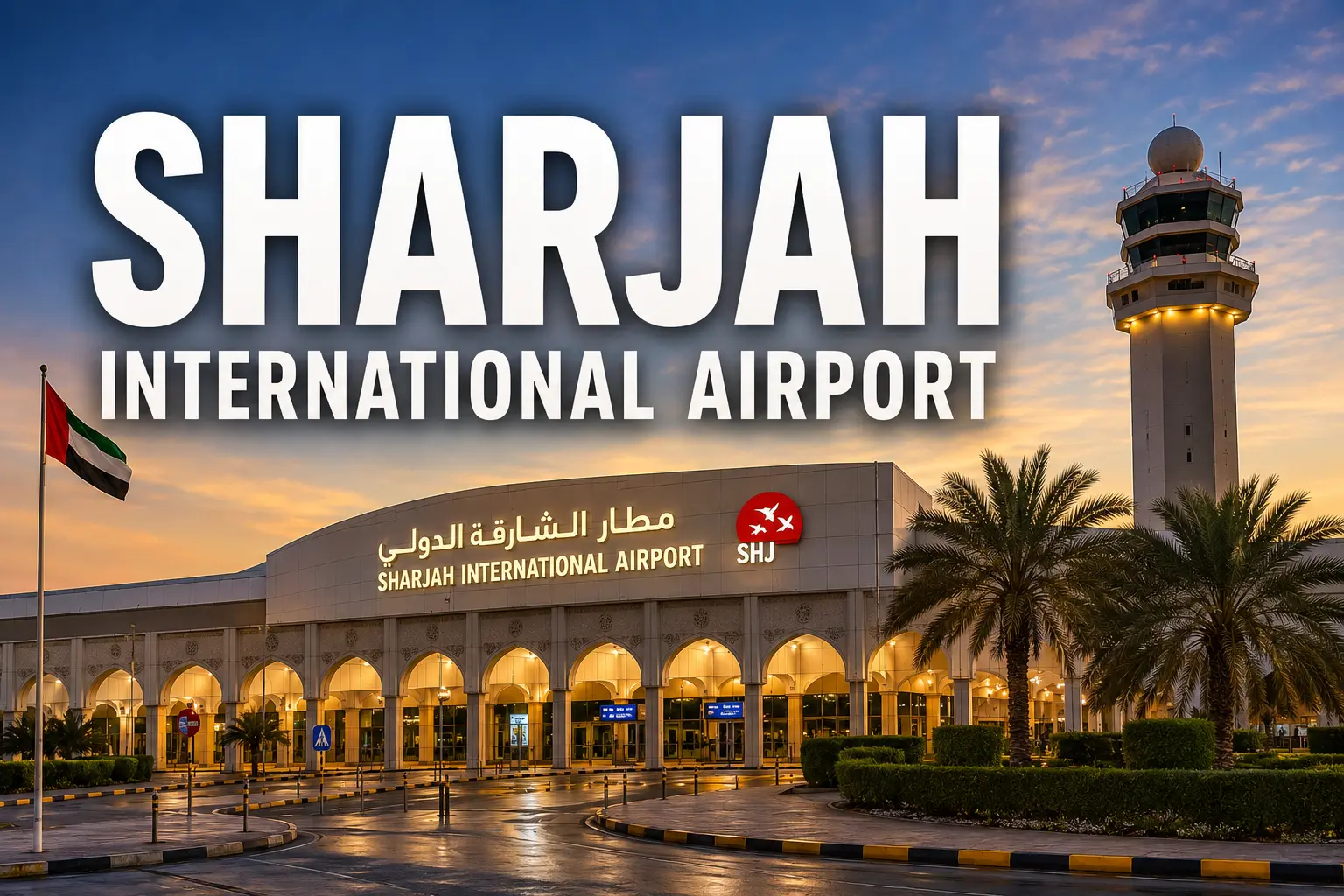
Sharjah International Airport (SHJ) is the third busiest airport in the UAE and the home base of Air Arabia, the Middle East’s first and largest low-cost carrier. In 2025, the airport handled a record 19.48 million passengers, a 13.9% increase over the previous year and its strongest performance to date. Aircraft movements reached 116,657 flights, up 8.3%, while air cargo volumes grew to 204,323 tonnes.
SHJ occupies a unique niche in the UAE’s aviation ecosystem. Located just 13 kilometers from Sharjah city center and approximately 25 kilometers from downtown Dubai, it offers a more compact, less congested, and often cheaper alternative to DXB and AUH. Air Arabia, which operates from the airport as its primary hub, connects Sharjah to over 100 destinations across the Middle East, North Africa, South Asia, Central Asia, and Europe.
The airport is undergoing a major AED 2.4 billion ($650 million) expansion that will increase capacity from approximately 20 million to 25 million passengers annually by 2027. The expansion includes a new terminal building, an additional runway, upgraded road networks, and enhanced cargo facilities. This guide covers everything about Sharjah International Airport: its history, current operations, expansion plans, airlines, facilities, and travel tips.
Quick Facts at a Glance
| Detail | Data |
| Official Name | Sharjah International Airport |
| IATA Code | SHJ |
| ICAO Code | OMSJ |
| Location | 13 km east-southeast of Sharjah city center |
| Area | 1,538 hectares |
| Elevation | 35 meters (116 feet) above sea level |
| Current Capacity | ~20 million passengers/year |
| Planned Capacity | 25 million passengers/year (by 2027) |
| Terminal | 1 passenger terminal (125,000 sqm) |
| Runways | 1 (4,060 m x 60 m, asphalt) |
| Hub Airline | Air Arabia |
| 2025 Passengers | 19.48 million |
| 2025 Aircraft Movements | 116,657 |
| 2025 Cargo | 204,323 tonnes |
| Expansion Cost | AED 2.4 billion ($650 million) |
| Operator | Sharjah Airport Authority |
| Phone | +971 6 558 1111 |
| Official Website | sharjahairport.ae |
History of Sharjah International Airport
From Imperial Airways Stopover to Modern Hub
The story of Sharjah International Airport begins in 1932, when an airfield known as RAF Sharjah was established at Al Mahatta as the first aviation facility in the region. The airfield served as a stopover for Imperial Airways flights connecting London to India, with the inaugural landing occurring on October 5, 1932, when the Imperial Airways aircraft Hanno touched down at 4:00 p.m. after departing from Gwadar.
The original site served as a critical refueling point that allowed flights to bypass restricted Persian airspace. Regular overnight stops were established, and Sharjah became part of the pioneering air route between Europe and Asia. The airfield was later used by the Royal Air Force and laid the foundation for regional air travel in the Arabian Gulf.
The modern Sharjah International Airport officially opened in 1977, designed with distinctive architectural elements to accommodate growing international demand. This marked the transition from its earlier military use to serving civilian flights and establishing Sharjah as a key gateway in the UAE.
In 1979, a freight center was established at the airport, and it was enlarged in 1999. A major passenger terminal upgrade was completed in 2008, reflecting the airport’s evolution into a multifaceted transport node. A new 4,060-meter runway, one of the longest in the region, was inaugurated in 2014, enabling wider-body aircraft operations.
The pivotal moment came in 2003, when Air Arabia, the Middle East’s first low-cost carrier, established Sharjah as its primary hub. This decision fundamentally transformed the airport’s trajectory, driving passenger growth through affordable routes to over 100 destinations and reinforcing SHJ’s niche in budget travel.
Key Milestones Timeline
| Year | Milestone |
| 1932 | RAF Sharjah airfield established as Imperial Airways stopover |
| 1977 | Modern Sharjah International Airport opens for commercial flights |
| 1979 | Freight center established at the airport |
| 1999 | Freight center enlarged |
| 2003 | Air Arabia establishes Sharjah as its primary hub |
| 2008 | Major passenger terminal upgrade completed |
| 2014 | New 4,060-meter runway inaugurated |
| 2019 | 13.6 million passengers; ranked 1st in MENA for punctuality |
| 2023 | 15.36 million passengers; AED 2.4 billion expansion announced |
| 2024 | 17.1 million passengers; expansion construction begins (January) |
| 2025 | 19.48 million passengers; record year with 13.9% growth |
Current Operations at SHJ
Passenger Terminal
SHJ has one passenger terminal covering 125,000 square meters (1,350,000 sq ft). The terminal has two levels: the ground floor handles arrivals, immigration, and baggage claim, while the first floor handles departures, check-in, and retail. The terminal serves all airlines operating from the airport.
Terminal facilities include duty-free shopping, restaurants and cafés, currency exchange, information desks, VIP lounges, and free Wi-Fi. The terminal is designed for efficient processing, with the airport’s philosophy focused on a “20 minutes in, 20 minutes out” timeframe for each passenger.
Cargo Facilities
SHJ is the third largest Middle East air freight hub in cargo tonnage, according to official statistics from Airports Council International. The airport has five cargo terminals, and Sharjah Aviation Services handled 586,195 tonnes in 2015. In 2025, cargo volumes reached 204,323 tonnes, with sea freight services through Sharjah airport rising to 16,770 tonnes, reflecting increasing demand for the emirate’s logistics corridor.
Airlines and Destinations
SHJ is served by over 20 airlines flying to more than 100 destinations. Air Arabia is the dominant carrier, accounting for the vast majority of flights and passengers.
| Category | Airlines |
| Low-Cost Carriers | Air Arabia (primary hub), Air Arabia Abu Dhabi, Air India Express, flydubai |
| Full-Service Carriers | Ethiopian Airlines, SalamAir, Caspian Airlines, Fly Cham |
| Regional Carriers | Pegasus, SunExpress, Airblue, Biman Bangladesh, US-Bangla Airlines |
| Other Airlines | Aeroflot, Azerbaijan Airlines, Turkish Airlines (seasonal) |
Top Destinations by Air Arabia
Air Arabia operates over 80 routes from Sharjah, including:
| Region | Destinations |
| India | Mumbai, Delhi, Bangalore, Kochi, Chennai, Hyderabad, Calicut, Trivandrum, Ahmedabad, Jaipur, Indore, Pune |
| Pakistan | Islamabad, Karachi, Lahore, Peshawar, Sialkot, Faisalabad |
| Egypt | Cairo, Alexandria, Assiut, Sohag |
| Europe | London (Gatwick), Munich, Prague, Warsaw, Vienna, Rome, Belgrade, Istanbul |
| Southeast Asia | Bangkok, Kuala Lumpur, Jakarta, Manila, Kathmandu, Krabi |
| Middle East | Amman, Beirut, Baghdad, Basra, Erbil, Jeddah, Riyadh, Dammam |
| Africa | Addis Ababa, Entebbe, Khartoum, Nairobi |
| Central Asia | Tashkent, Namangan,乌鲁木齐 |
| Russia | Moscow, Sochi, Kazan, Mineralnye Vody |
Passenger Traffic Statistics
Annual Passenger Numbers
| Year | Passengers | Aircraft Movements | Cargo (tonnes) |
| 2014 | 7.2 million | 52,000 | 320,000 |
| 2016 | 11.0 million | 78,000 | 450,000 |
| 2018 | 12.0 million | 88,000 | 500,000 |
| 2019 | 13.6 million | 98,433 | 586,195 |
| 2020 | 5.7 million | 48,000 | 280,000 |
| 2021 | 8.5 million | 65,000 | 350,000 |
| 2022 | 13.1 million | 98,433 | 480,000 |
| 2023 | 15.36 million | 98,433 | 520,000 |
| 2024 | 17.1 million | 107,760 | 195,909 |
| 2025 | 19.48 million | 116,657 | 204,323 |
Growth Drivers
- Air Arabia’s aggressive network expansion with 81+ routes
- New airlines joining: SalamAir, Caspian Airlines, Fly Cham, Ethiopian Airlines
- New European destinations: London, Munich, Prague, Warsaw, Vienna, Rome
- Growing Indian subcontinent connectivity
- Competitive pricing compared to DXB and AUH
- Sharjah’s growing tourism and cultural appeal
- Proximity to Dubai (25 km from downtown)
AED 2.4 Billion Expansion Project
Sharjah International Airport is undergoing its most significant expansion since opening. The AED 2.4 billion ($650 million) project was announced in 2023, with construction beginning in January 2024. The expansion is designed to increase the airport’s capacity to 25 million passengers annually by 2027.
Expansion Components
- New terminal building: 190,000 square meters of additional space
- Separation of arrivals and departures areas for smoother passenger flow
- New departures terminal separate from the existing arrivals terminal
- Additional runway (second runway for the airport)
- New aircraft parking stands and apron pads
- New road network and vehicle parking areas (1,120+ parking spaces)
- New VIP lounge with separate entry and exit
- Upgraded airport systems and amenities
- Enhanced cargo and logistics facilities
- Road network linking the new terminal with existing facilities
Construction Progress (2025)
In February 2025, Sheikh Sultan bin Mohammed bin Sultan Al Qasimi, Crown Prince and Deputy Ruler of Sharjah, reviewed the latest developments of the expansion project. Completed milestones include:
- Project and public services building
- New aircraft parking stands
- Road network design
- Vehicle parking areas
Ongoing work includes supply phases, packages in the design stage, and projects under tendering. The entire expansion is anticipated to be completed by the close of 2027.
Long-Term Vision
The Sharjah Airport Authority has launched a series of projects designed to improve logistics operations and align infrastructure with environmental sustainability standards. Key initiatives focus on reducing carbon emissions while enhancing service quality and operational efficiency. The authority’s strategy targets a position among the top five regional airports renowned for travel experience and customer service.
SHJ vs DXB vs AUH: How Sharjah Compares
| Feature | SHJ (Sharjah) | DXB (Dubai) | AUH (Abu Dhabi) |
| Location | Sharjah, 13 km from city | Dubai, 4.6 km from city | Abu Dhabi, 30 km from city |
| Annual Capacity | 20 million (expanding to 25M) | 115 million | 45 million |
| Passengers (2025) | 19.48 million | 95.2 million | 32.5 million |
| Hub Airline | Air Arabia | Emirates | Etihad Airways |
| Carrier Type | Low-cost focus | Full-service | Full-service |
| Runways | 1 | 2 | 2 |
| Terminals | 1 | 3 | 1 (Terminal A) |
| Terminal Size | 125,000 sqm | Multiple | 742,000 sqm |
| Ticket Prices | Cheapest | Mid-range | Premium |
| Congestion | Low | High | Moderate |
Getting to and from SHJ
SHJ is located approximately 13 kilometers east-southeast of Sharjah city center along Al Dhaid Road. It is also accessible from Dubai, approximately 25 kilometers from downtown Dubai.
Taxi and Rideshare
Official taxis and ride-hailing services (Uber, Careem) are available at the airport. The ride to Sharjah city center takes approximately 15-20 minutes, while the ride to downtown Dubai takes 25-40 minutes depending on traffic.
Bus
Public bus services connect SHJ to Sharjah’s city center and other emirates. The bus is the cheapest option, with fares starting at AED 3-5.
Car Rental
All major car rental companies are available at the airport. SHJ is well connected to the E88 and E311 highways, providing easy access to Dubai, Ajman, and other emirates.
Transport Comparison
| Mode | Cost to Sharjah City | Cost to Dubai | Travel Time |
| Taxi/Uber/Careem | AED 20-30 | AED 50-80 | 15-20 min / 25-40 min |
| Bus | AED 3-5 | AED 10-15 | 30-45 min |
| Car Rental | Varies | Varies | 15-20 min / 25-40 min |
Facilities and Services
Duty-Free
SHJ offers duty-free shopping with a range of products including perfumes, electronics, tobacco, confectionery, and local products. The duty-free is popular among budget travelers looking for competitive prices.
Lounges
The airport offers VIP lounges for premium passengers and transit travelers. Lounges provide comfortable seating, complimentary food and beverages, Wi-Fi, and business facilities.
Hotels
Several hotels are located near the airport, including budget and mid-range options. The Sharjah Airport Hotel is located within the terminal for transit passengers.
Dining
The terminal features restaurants, cafés, and fast-food outlets catering to different tastes and budgets. Options include local Emirati cuisine, international chains, and coffee shops.
Other Services
- Free Wi-Fi throughout the terminal
- Currency exchange and banking services
- Medical services and first aid
- Prayer rooms
- Car rental desks
- Tourist information
- Left luggage and baggage wrapping
- ATMs and cash machines
Tips for Travelers
Fly Air Arabia for the best deals. SHJ is Air Arabia’s home base, and the airline offers the most routes and the cheapest fares from the airport. Book directly on airarabia.com for the best prices.
Check if SHJ is closer to your destination. If you are staying in northern Sharjah, Ajman, or even parts of Dubai (Deira, Bur Dubai), SHJ may be closer and cheaper than DXB.
Arrive early for international flights. SHJ is smaller than DXB and AUH, but international check-in can still take time during peak hours. Arrive 2-3 hours before departure.
Use online check-in. Air Arabia offers online check-in 24 hours before departure. This saves time at the airport and allows you to go straight to security.
Explore Sharjah during layovers. Sharjah is a cultural hub with museums, art galleries, and the Sharjah Heritage Area. The Al Noor Mosque and Sharjah Arts Museum are worth visiting.
Compare prices with DXB. Sometimes flights from DXB are cheaper or have better schedules. Always compare SHJ and DXB before booking.
Book airport parking in advance. Parking can fill up during peak travel periods. Book your parking spot online to guarantee availability.
Limitations
SHJ has only one runway and one terminal, which limits its capacity during peak periods. While the expansion will add a second runway and new terminal, construction disruptions may affect operations until completion in 2027.
The airport’s focus on low-cost carriers means that premium services are limited compared to DXB and AUH. Business class lounges, fine dining, and luxury retail options are more restricted.
Public transport connections are limited. There is no metro link to SHJ, and bus services are infrequent compared to DXB. Travelers relying on public transport may find the options inconvenient.
SHJ serves fewer long-haul destinations than DXB or AUH. Passengers flying to the Americas, Australasia, or East Asia will typically need to connect through Dubai or Abu Dhabi.
Conclusion
Sharjah International Airport has carved out a distinctive position in the UAE’s aviation landscape. As the home of Air Arabia and a gateway for budget travelers, SHJ offers a compelling alternative to the mega-hubs of Dubai and Abu Dhabi. With 19.48 million passengers in 2025 and 19 consecutive quarters of double-digit growth, the airport is proving that the low-cost model works at scale.
The AED 2.4 billion expansion underway will transform SHJ from a single-runway, single-terminal airport into a 25-million-passenger facility with modern infrastructure, separated arrivals and departures, and enhanced cargo capabilities. The project, expected to complete in 2027, will position SHJ as a serious competitor in the regional aviation market.
For budget-conscious travelers, SHJ represents the best value proposition in UAE aviation. Air Arabia’s extensive network of 80+ destinations, combined with the airport’s compact design and efficient processing, makes it an attractive choice for millions of passengers each year. As Sharjah continues to develop its cultural, tourism, and economic infrastructure, SHJ will play an increasingly important role in the emirate’s growth story.
FAQ
What is Sharjah International Airport?
Sharjah International Airport (SHJ) is the primary international airport serving the emirate of Sharjah, UAE. It is the home base of Air Arabia, the Middle East’s first low-cost carrier, and handled 19.48 million passengers in 2025.
How many passengers does SHJ handle?
SHJ handled a record 19.48 million passengers in 2025, a 13.9% increase over 2024. The airport is expanding to reach 25 million passengers annually by 2027.
Which airlines fly from SHJ?
SHJ is served by over 20 airlines, with Air Arabia being the dominant carrier. Other airlines include Air India Express, Ethiopian Airlines, SalamAir, Pegasus, and flydubai.
Is SHJ closer to Dubai than DXB?
SHJ is located 13 km from Sharjah city center and approximately 25 km from downtown Dubai. For travelers staying in northern Sharjah, Ajman, or parts of Dubai like Deira, SHJ can be closer than DXB.
What is the expansion plan for SHJ?
SHJ is undergoing a AED 2.4 billion ($650 million) expansion to increase capacity from 20 million to 25 million passengers annually. The project includes a new terminal, second runway, and upgraded facilities, expected to complete by 2027.
How do I get from SHJ to Dubai?
Taxis and ride-hailing services (Uber, Careem) are available, with the ride to downtown Dubai taking 25-40 minutes and costing AED 50-80. Public buses also connect SHJ to Dubai.
Is SHJ a good airport for budget travel?
Yes. SHJ is the home of Air Arabia and specializes in low-cost flights. Fares from SHJ are often significantly cheaper than from DXB or AUH, making it the best choice for budget-conscious travelers.
What cargo does SHJ handle?
SHJ is the third largest Middle East air freight hub. It handled 204,323 tonnes of cargo in 2025 and offers sea-air cargo services through Sharjah’s logistics corridor.