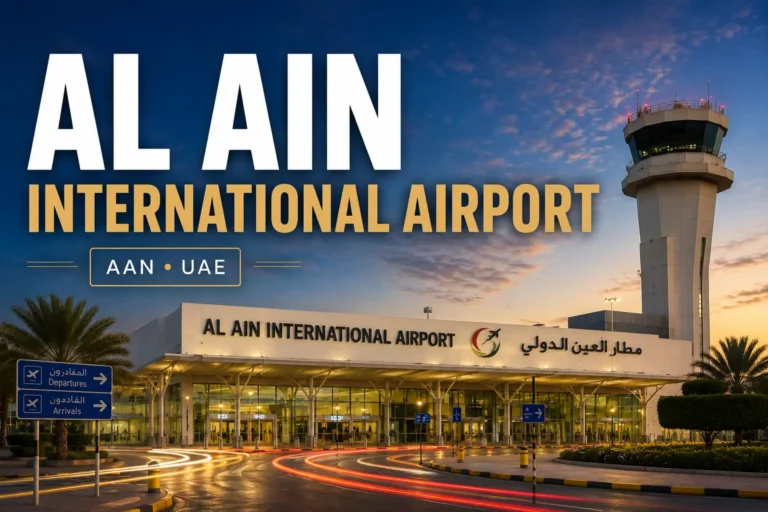
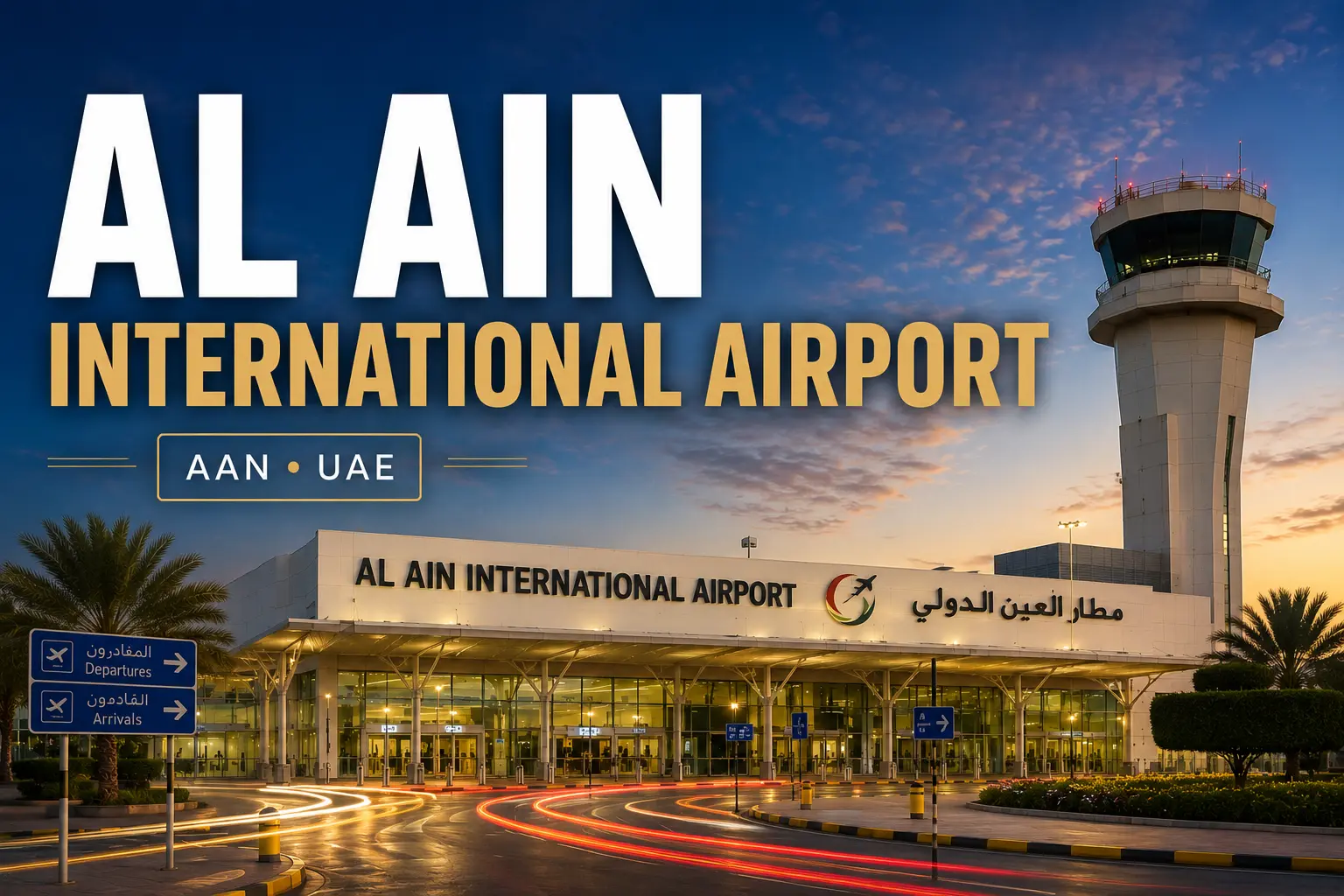
Al Ain International Airport (AAN) is Abu Dhabi’s second international airport and the fifth busiest in the UAE. Located 18 kilometers northwest of Al Ain city in the Eastern Region of the Emirate of Abu Dhabi, the airport serves as a vital gateway connecting the UAE’s “Garden City” to regional and international destinations. In 2025, the airport recorded significant passenger growth of 48.1% year-on-year in the fourth quarter, with annual traffic up 9.2%, signalling growing demand on regional and niche routes.
Operating since 31 March 1994, AAN has evolved from a small regional airfield into a multifaceted aviation facility that combines passenger services, cargo operations, aerospace manufacturing, pilot training, and military maintenance. The airport is operated by Abu Dhabi Airports Company and is home to the Nibras Al Ain Aerospace Park, the UAE’s first dedicated aerospace cluster spanning 36 square kilometers.
While AAN handles approximately 200,000 passengers annually — modest compared to Abu Dhabi International Airport (AUH) or Dubai International (DXB) — its strategic importance lies in its role as a catalyst for Al Ain’s economic development, tourism growth, and aerospace industrial diversification. A comprehensive five-year development plan, reviewed by Sheikh Hazza bin Zayed Al Nahyan in September 2025, aims to modernize infrastructure, double capacity, attract new airlines, and position the airport as a regional aviation and logistics hub.
Quick Facts at a Glance
| Detail | Data |
| Official Name | Al Ain International Airport |
| IATA Code | AAN |
| ICAO Code | OMAL |
| Arabic Name | مَطَار ٱلْعَيْن ٱلدَُوَلِِي |
| Location | 18 km northwest of Al Ain city, Abu Dhabi Emirate |
| Opened | 31 March 1994 |
| Operator | Abu Dhabi Airports Company |
| Area | 1,538 hectares |
| Elevation | 264 meters (866 feet) above sea level |
| Runway | 01/19 — 4,000 m x 60 m (asphalt) |
| Parallel Taxiway | 4,000 m (can double as runway) |
| Terminal | 1 passenger terminal |
| Check-in Desks | 10 (including 1 business class) |
| Gates | 3 |
| Cargo Terminal | 2,000 sqm |
| Annual Passengers | ~200,000 (2025) |
| Destinations | 5-6 international |
| Airlines | 5 scheduled carriers |
| Phone | +971 (03) 785 5555 |
| Official Website | abudhabiairports.ae |
History of Al Ain International Airport
Origins and Early Planning
The planning for Al Ain International Airport originated in the early 1970s amid the rapid urbanization and economic expansion of Al Ain, driven by the UAE’s burgeoning oil sector. The need for improved regional air connectivity for the eastern emirate led to the development of an airport that could serve Al Ain’s growing population and its proximity to the Hajar Mountains and the Oman border.
Construction of the modern airport facility began in the early 1990s, and the airport officially opened on 31 March 1994. From its inception, AAN was designed to complement Abu Dhabi International Airport by serving the specific needs of Al Ain’s population, which includes significant South Asian and Middle Eastern communities requiring direct regional connections.
Growth and Development
In its early years, the airport operated with limited regional flights and modest passenger volumes. By 2017, annual transit passengers had reached 22,469, reflecting its steady role in regional connectivity. The airport gradually expanded its airline base, adding carriers that connected Al Ain to key destinations in the Indian subcontinent, Middle East, and Africa.
A significant milestone came in 2014 with the development of the Al Ain International Airport Master Plan, which proposed the construction of a new passenger terminal adjacent to the existing one and outlined the creation of an aerospace cluster with airside access. This master plan integrated with the broader Plan Al Ain 2030 urban framework, emphasizing sustainable development around the airport through logistics parks, commercial districts, and residential neighborhoods.
In September 2025, a comprehensive five-year development plan was reviewed by His Highness Sheikh Hazza bin Zayed Al Nahyan, Ruler’s Representative in Al Ain Region. The plan includes upgrading infrastructure to the highest international standards, attracting new airlines, and expanding the airport’s role as a logistics and aviation hub for the Al Ain Region.
Key Milestones
| Year | Milestone |
| 1970s | Planning for Al Ain airport begins amid regional economic growth |
| 1994 | Al Ain International Airport officially opens on 31 March |
| 2014 | Al Ain International Airport Master Plan developed |
| 2017 | Annual transit passengers reach 22,469 |
| 2024 | Q4 passenger growth of 48.1% year-on-year |
| 2025 (Sep) | Five-year development plan reviewed by Sheikh Hazza bin Zayed |
| 2025 (Oct) | Abu Dhabi Airports signs agreement with Hafeet Rail for rail connectivity |
| 2025 | Annual passenger growth of 9.2%; ~200,000 passengers handled |
Current Operations at AAN
Terminal and Facilities
AAN currently consists of a single passenger terminal with 10 check-in desks (including one dedicated to business class travelers) and three gates. The terminal is designed for efficient processing of regional flights and handles approximately 200,000 passengers annually. While modest in scale compared to AUH or DXB, the terminal provides essential services including duty-free shopping, currency exchange, information desks, prayer rooms, and free Wi-Fi.
The airport also features a dedicated cargo terminal spanning 2,000 square meters, designed to handle regional freight shipments. This facility supports the airport’s integration with the UAE’s broader logistics network, including proximity to industrial zones in Al Ain.
Runway and Airside
AAN has one primary runway designated 01/19, measuring 4,000 meters (13,140 feet) in length with an asphalt surface. This is one of the longest runways in the UAE, enabling the airport to accommodate wide-body aircraft including the Airbus A350-1000, which successfully completed hot-weather testing at the airport in 2017.
A parallel 4,000-meter taxiway runs alongside the main runway and can double as a runway when needed, providing operational flexibility. The airside area includes apron expansion and taxiway widening projects to support growing aircraft movements.
Airlines and Destinations
AAN is served by five scheduled international airlines, connecting Al Ain to destinations across the Middle East, South Asia, and Africa. The airport serves a mix of leisure travelers, business passengers, and expatriates from Al Ain’s diverse population.
| Airline | Destination | Type |
| Air India Express | Kozhikode (CCJ), India | Year-round |
| Jazeera Airways | Kuwait City (KWI), Kuwait | Seasonal (Nov-Mar) |
| Nile Air | Cairo (CAI), Egypt | Seasonal (Nov-Mar) |
| Pakistan International Airlines | Islamabad (ISB), Pakistan | Year-round |
| Maldivian | Malé (MLE), Maldives | Year-round |
| Ariana Afghan Airlines | Khost, Afghanistan | Seasonal |
| Etihad Airways | Jeddah (JED), Saudi Arabia | Seasonal |
These routes provide affordable connectivity for short- to medium-haul travel. The airport’s focus on regional destinations in the Indian subcontinent and Middle East reflects Al Ain’s demographic profile, with significant expatriate communities from Pakistan, India, and Egypt.
Passenger Traffic
AAN handles approximately 200,000 passengers annually, making it the fifth busiest airport in the UAE. While this is modest compared to AUH (32.5 million in 2025) or DXB (95.2 million), the airport has shown remarkable growth rates. In Q4 2025, passenger traffic grew 48.1% year-on-year, with annual traffic up 9.2%.
The growth reflects increasing demand on regional routes, driven by Al Ain’s growing population, tourism appeal, and the airport’s role as a convenient alternative to the larger, more congested hubs in Abu Dhabi and Dubai.
Nibras Al Ain Aerospace Park
AAN plays a vital role as the location for Nibras Al Ain Aerospace Park, the UAE’s first dedicated aerospace cluster. Jointly developed by Mubadala Aerospace and Abu Dhabi Airports, the 36 km² aerospace park has brought together world-class aerospace manufacturers and suppliers, research and knowledge institutions, and educational and scientific bodies.
Park Components
- Industrial projects and aerospace manufacturing facilities
- Business and office facilities for aviation companies
- Mixed-use and residential zones with community amenities
- Five km² specifically allocated to the aerospace industry
- Research and educational institutions
- Logistics parks and commercial districts
AMMROC
The airport is home to AMMROC (Advanced Military Maintenance, Repair and Overhaul Center), which provides industry-leading maintenance, repair and overhaul (MRO) services and integrated logistics support for the military and civil aviation sectors. AMMROC’s world-class facilities and highly qualified workforce make it a leading international third-party MRO service provider, undertaking fleet-wide Performance Based Logistics (PBL) programs for Air Force customers.
Pilot Training
AAN serves as a home base for civilian and military pilot training programs. The airport’s relatively uncongested airspace and long runway make it an ideal training facility for flight schools and military aviation programs.
Sustainability Role
The Nibras Al Ain Aerospace Park is designed to become a long-term economic development and diversification catalyst for Abu Dhabi. The vision is to establish a sustainable aerospace industry in Abu Dhabi, becoming a global hub for aerospace recognized for knowledge-driven innovation and renowned for nurturing integrated partnerships across the supply chain.
Five-Year Development Plan
In September 2025, His Highness Sheikh Hazza bin Zayed Al Nahyan received a delegation from Abu Dhabi Airports, led by CEO Elena Sorlini, to review a comprehensive five-year development plan for Al Ain International Airport. The plan aims to strengthen the airport’s role as a vital hub for aviation and logistics.
Plan Components
- Upgrading airport infrastructure and main facilities to meet the highest international standards
- Increasing operational capacity to accommodate growing passenger and cargo volumes
- Attracting regional and international airlines to expand the route network
- Developing a new VVIP terminal for high-profile passengers
- Enhancing cargo infrastructure to support logistics growth
- Expanding MRO facilities within the Nibras Al Ain Aerospace Park
- Improving ramp operations and airside facilities
- Installing new CCTV and MSSR Radar systems
- Increasing the sizes of the departure lounge and check-in areas
- Building a new hi-tech airline in-flight catering facility
Rail Connectivity
On 1 October 2025, Abu Dhabi Airports signed an agreement with Hafeet Rail to enhance multi-modal connectivity at the airport, integrating rail links to improve access and support regional economic development. This agreement will connect AAN to the broader UAE rail network, improving passenger and cargo access to the airport.
Master Plan Integration
The development plan integrates with the broader Plan Al Ain 2030 urban framework, which emphasizes sustainable development around the airport through logistics parks, commercial districts, and residential neighborhoods. The framework incorporates extensive green spaces totaling over 1.75 million square meters, preserving Al Ain’s environmental heritage while supporting urban expansion.
The master plan, developed by SCB in collaboration with Ricondo & Associates, encompasses 10 million square meters and outlines the creation of an Aerospace Cluster with airside access, surrounded by a multi-use Business Logistics Park offering light industrial and warehouse facilities for distribution and manufacturing services.
AAN vs AUH vs DXB: How Al Ain Compares
| Feature | AAN (Al Ain) | AUH (Abu Dhabi) | DXB (Dubai) |
| Location | Al Ain, 18 km from city | Abu Dhabi, 30 km from city | Dubai, 4.6 km from city |
| Annual Capacity | ~500,000 | 45 million | 115 million |
| Passengers (2025) | ~200,000 | 32.5 million | 95.2 million |
| Hub Airline | None (regional) | Etihad Airways | Emirates |
| Runways | 1 | 2 | 2 |
| Terminal | 1 (small) | 1 (Terminal A) | 3 |
| Check-in Desks | 10 | 150+ | 300+ |
| Gates | 3 | 78 | 95+ |
| Airlines | 5 | 25+ | 120+ |
| Destinations | 5-6 | 120+ | 260+ |
| Runway Length | 4,000 m | 4,100 m | 4,000 m |
| Unique Feature | Aerospace Park | Terminal A design | Concourse A |
Getting to and from AAN
AAN is located 18 kilometers northwest of Al Ain city center along the Al Ain-Dubai highway. The airport is also accessible from Abu Dhabi (approximately 150 km) and Dubai (approximately 140 km).
Taxi and Rideshare
Taxis and ride-hailing services (Uber, Careem) are available at the airport. The ride to Al Ain city center takes approximately 15-20 minutes, while the ride to Abu Dhabi takes approximately 1.5-2 hours and to Dubai approximately 1.5-2 hours.
Bus
Public bus route 496 connects the airport to Al Ain central station, Al Ain Town Square, and Al Ain Mall. The service runs several times daily with a fare of AED 2, taking approximately 30 minutes from the airport to the city center.
Car Rental
All major car rental companies are available at the airport. AAN is well connected to the E66 (Al Ain-Dubai) and E22 (Al Ain-Abu Dhabi) highways, providing easy access to other emirates.
Rail (Future)
Under the October 2025 agreement with Hafeet Rail, AAN will be connected to the UAE’s rail network, providing a future option for passenger and cargo rail access to the airport.
Transport Comparison
| Mode | Cost to Al Ain City | Cost to Abu Dhabi | Cost to Dubai |
| Taxi/Uber | AED 15-25 | AED 150-200 | AED 150-200 |
| Bus | AED 2 | AED 25-35 | AED 25-35 |
| Car Rental | Varies | Varies | Varies |
Facilities and Services
Terminal Amenities
- Duty-free shopping with perfumes, electronics, and confectionery
- Currency exchange and banking services
- Prayer rooms for men and women
- Free Wi-Fi throughout the terminal
- Information desks with multilingual staff
- ATMs and cash machines
- Left luggage and baggage wrapping services
- Car rental desks
Parking
The airport has approximately 420 parking spaces available for short-term (hourly) and long-term (daily) stays directly outside the terminal building. Parking is generally affordable and rarely fills to capacity, unlike larger UAE airports.
Hotels Near AAN
There is no hotel within the airport terminal, but several hotels are located in Al Ain city center, approximately 15-20 minutes away:
- Al Ain Rotana — 5-star hotel with full amenities
- Hilton Al Ain — International chain hotel
- InterContinental Hotel Al Ain — Premium business hotel
- Mercure Grand Hotel Al Ain — Mid-range option
- City Seasons Al Ain — Budget-friendly choice
Nearby Attractions
Al Ain is known as the “Garden City” of the UAE and offers several attractions for visitors:
- Al Ain Oasis — UNESCO World Heritage Site with 147,000 date palms
- Jebel Hafeet — UAE’s second-highest peak at 1,249 meters
- Al Ain Wildlife Park & Resort — Zoo and safari park
- Al Ain National Museum — Archaeological and cultural exhibits
- Green Mubazzarah — Hot springs and park at the foot of Jebel Hafeet
- Al Ain Mall — Shopping and entertainment
Tips for Travelers
Check airline schedules carefully. AAN has limited flight frequencies. Some routes are seasonal (November-March), and schedules can change. Always verify flight availability before booking.
Use AAN as an alternative to AUH. If you are traveling to Al Ain or the eastern regions of Abu Dhabi Emirate, AAN is much closer and less congested than AUH. Factor in the 1.5-2 hour drive from Abu Dhabi city to AUH.
Combine with Al Ain tourism. Al Ain is a UNESCO World Heritage city with unique attractions. Use AAN as a gateway to explore the Garden City, Jebel Hafeet, and the Al Ain Oasis.
Arrive early. While AAN is small and processing is generally quick, international check-in can take time during peak hours. Arrive 2 hours before departure.
Book car rental in advance. Al Ain is a car-dependent city. Public transport is limited, so renting a car is the best way to explore the region.
Consider Etihad connections. Etihad Airways offers seasonal flights from AAN to Jeddah. For other destinations, you can connect through AUH or DXB.
Enjoy the quiet experience. AAN is one of the least congested airports in the UAE. Enjoy the short queues, quick processing, and relaxed atmosphere.
Limitations
- Limited airline and destination choices — only 5-6 routes available
- Small terminal with basic amenities compared to AUH or DXB
- No metro or rail connection (planned for the future)
- Limited public transport options within Al Ain
- No hotel within the terminal
- Seasonal route availability — some destinations only operate November-March
- Limited cargo facilities compared to major UAE airports
FAQ
What is Al Ain International Airport?
Al Ain International Airport (AAN) is Abu Dhabi’s second international airport, located 18 kilometers northwest of Al Ain city. It opened in 1994 and handles approximately 200,000 passengers annually, serving as a gateway to the UAE’s “Garden City.”
Which airlines fly from AAN?
AAN is served by five scheduled airlines: Air India Express (Kozhikode), Jazeera Airways (Kuwait City), Nile Air (Cairo), Pakistan International Airlines (Islamabad), and Maldivian (Malé). Some routes are seasonal.
How many passengers does AAN handle?
AAN handles approximately 200,000 passengers annually. In Q4 2025, passenger traffic grew 48.1% year-on-year, with annual growth of 9.2%.
Is AAN the same as AUH?
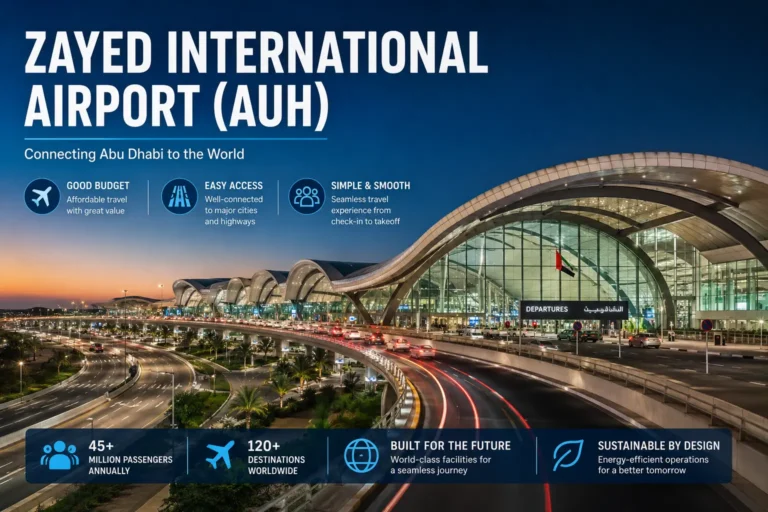
No. AAN (Al Ain International Airport) is in Al Ain, while AUH (Zayed International Airport, formerly Abu Dhabi International Airport) is in Abu Dhabi city. They are approximately 150 km apart.
What is the Nibras Al Ain Aerospace Park?
Nibras is the UAE’s first dedicated aerospace cluster, spanning 36 km² at AAN. It houses aerospace manufacturers, MRO facilities (AMMROC), research institutions, and pilot training programs.
What are the expansion plans for AAN?
A five-year development plan reviewed in September 2025 includes infrastructure upgrades, a new VVIP terminal, expanded MRO facilities, enhanced cargo infrastructure, and integration with the UAE rail network via Hafeet Rail.
How do I get from AAN to Dubai?
Taxis and car rental are the primary options, with the journey taking 1.5-2 hours via the E66 highway. Public buses connect AAN to Al Ain city, from which intercity buses to Dubai are available.
What is the runway length at AAN?
AAN has a 4,000-meter (13,140-foot) asphalt runway, one of the longest in the UAE, capable of accommodating wide-body aircraft including the Airbus A350.
Does AAN have a cargo terminal?
Yes. AAN has a 2,000 sqm cargo terminal designed for regional freight shipments. Expansion plans are underway to enhance cargo infrastructure.